- Transit of Venus – for schools

Transit of Venus – for schools
It’s free, it’s fun and it’s right on the school curriculum

Paths of Venus across the Sun

Paths of Venus across the Sun in 2004 and 2012, as seen from Australia. Background Sun image credit – SDO/HMI; Venus transit graphics – Nick Lomb.

Venus came between the Earth and the Sun on June 6th 2012, between 8:16am and 2:44 pm, as visible from Eastern Australia.

Although the next transit of Venus will not occur for another 105 years, there is plenty of interesting information to explore on this page.

Sydney Observatory’s transit of Venus webpages and blog are great places to start for transit of Venus information.

Our guide to safe viewing of the transit provides information you need to avoid serious and possibly irreversible damage to your eyes if observing the Sun.

Sydney Observatory safe solar specsThese three websites are very highly recommended, each of which has a host of excellent educational resources:
The Transit of Venus website, produced in the Netherlands, is part of the Astronomers without Borders program.

The Transit of Venus website from the USA.

SunAeon’s Transit of Venus website has many resources including showing what you can expect to see through solar spectacles.

View the excellent and fun short video, Measuring the Universe, by the Royal Observatory Greenwich. Here’s information about their related exhibition, and more of their videos.

James CookDuring the transit
If the weather is clear at Sydney Observatory, the view from our telescope will be streamed free and live to ninemsn throughout the transit.

Download this FREE iphone and ipad app and tap your results on the day.

Watch the crew of the HMB Endeavour as they head to Lord Howe Island to view the transit of Venus with Sydney Observatory astronomer Carlos Bacigalupo who will be posting on our blog from Lord Howe Island.

Primary school resources
The event is directly relevant to the curriculum. Our Senior Education Officer, Geoff Wyatt, has produced a Transit of Venus educational activities booklet which you can print double-sided and staple together as a flip book showing the transit of Venus. You don’t have to visit Sydney Observatory to use these.

The Transit of Venus Project Management Committee, Australia, have produced excellent resources and teaching plans

Geoffrey Wyatt's award-winning 2004 transit of Venus image

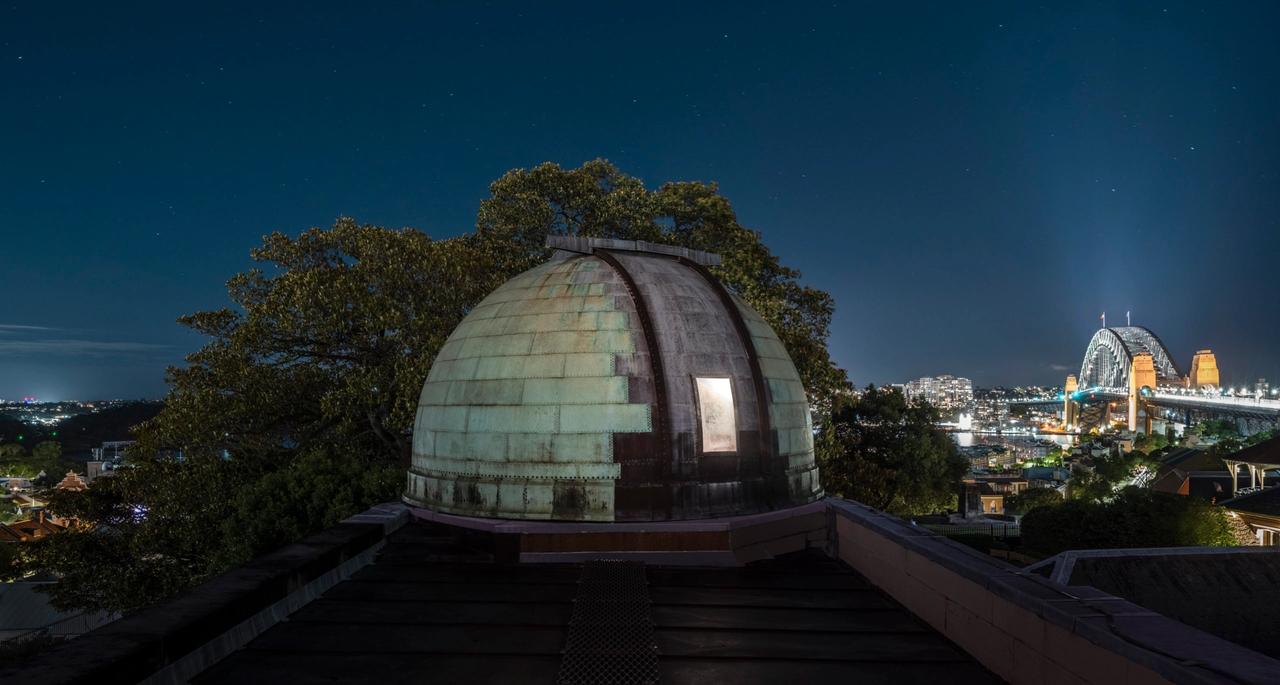
Geoffrey Wyatt's award-winning 2004 transit of Venus image, taken in the north dome of Sydney Observatory through a special filter that only transmits the red light of hydrogen atoms

High school resources
A short video, Measuring the Universe, by Royal Observatory Greenwich.

Explaining parallax – for the mathematically-minded.

Practise your skill at logging the contact times for the transit of Venus and then delve into parallax and the maths used to calculate the Astronomical Unit (AU). Produced by Dr Paul Payne, popular science educator for Sydney Observatory. The four contact times are: 1) When Venus first appears to touch the Sun; 2) When Venus first appears fully inside the Sun; 3) When Venus last appears fully inside the Sun; 4) When Venus appears to leave the Sun.

Engage with the interactive created by Dr Paul Payne to simulate the transit of Venus and help you to understand the phenomenon.

Download this humorous and beautifully presented comic novel. This work is available at no cost, and is licensed under Creative Commons, and hence we encourage you to distribute, email, print, photocopy, post and host these files! Be careful though because the times are set for observers in India.

Illustration inspired by 1874 transit of VenusThe Transit of Venus Project Management Committee, Australia, have produced excellent resources and teaching plans

NASA’s Sun Earth Day webcast

Tweet your experience using the following hashtags:
#sydneyobs, #tov2012 and #VenusTransit

Further recommended webcasts and sites (provided courtesy Transit of Venus Project Management Committee, Australia)

NASA’s Sun Earth Day page contains many student activities across all year levels about a range of astronomy related topics including the transit

Student mathematics exercises focused on the transit and the geometry of the solar system. Downloadable pdf.

Shelton clockAstronomy and mathematics student activities mainly focused on discovering exoplanets (planets outside our Solar System) using transits across distant stars.

Classroom activities near the bottom of this page mainly aimed at classroom demonstrations of how transits occur.

Smithsonian Institute educational resources – lessons in Mathematics, Science, English, History and Geography related to the transit. Created for the 2004 transit but still very relevant.

Articles and teacher resources relating the transit to maths & science, the arts, music, video and new mdia.

Space maths problems from NASA related to transits, eclipses and occultations together with explanatory images and diagrams. Downloadable pdf

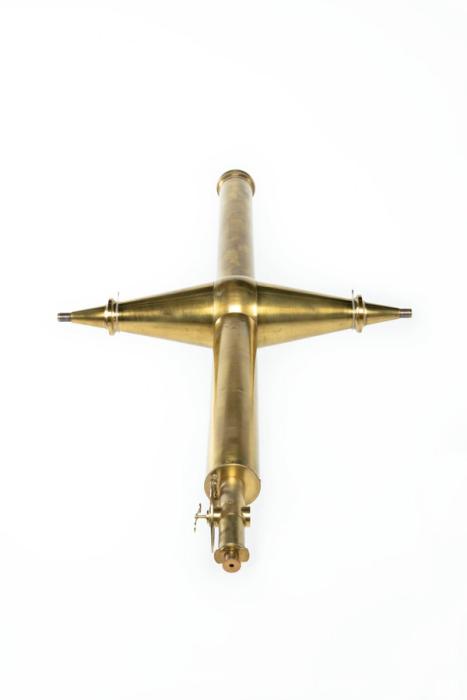
PhotoheliographLinks to other websites with information on the transit of Venus

NASA website with technical detail on the 2012 transit

NASA website with technical detail on transits and information for both the 2004 and 2012 transit

Transit of Venus website. Has details of the transit, transit history, safe viewing information, educational resources etc.

Transit of Venus orreryWebsite dedicated to the 2012 transit with a calculator for transit circumstances, global experiment to coordinate transit timing to measure the AU, information on transits and the history of transits educational resources etc.

NASA advice on methods of safe viewing of the transit

Information on safe solar viewing including a six minute video for kids.

4 minute YouTube video mainly of images of the 2004 transit.