
The position of the Sun and Venus from the beginning to the end of the transit as seen from Adelaide. Drawing Nick Lomb
From New Zealand and from most of Australia all the six and a half hours of the 2012 transit of Venus is visible, weather permitting. From Western Australia the transit will already be underway as the Sun rises. Just because the transit is visible from beginning to end does not, however, mean that it will be easy to see all of the transit, for June is winter in the Southern Hemisphere and the Sun will be low in the sky.
As the Sun will be low in the sky prior planning is essential to see the required phases of the transit. For those who just want to see Venus on the Sun the best time will be in the middle of the transit when Venus is well inside the Sun and relatively high in the sky. It will be possible to take interesting photos at that time, especially if there are wisps of cloud around to give a sense of drama.

The position of the Sun and Venus from the beginning to the end of the transit as seen from Melbourne. Drawing Nick Lomb
Historically the more interesting phenomena occur at the beginning of the transit (ingress) as Venus moves onto the disc of the Sun and at the end of the transit (egress) as Venus moves off the Sun. The infamous black drop effect is a dark linkage joining the dark silhouette of Venus to the inside edge of the Sun at about the time of second and third contacts – when Venus appears to touch the inside edge of the Sun at ingress and then at egress. For James Cook and many other observers of transit in past centuries this effect made it difficult to time the contacts as accurately as they wanted.
Today we know that this effect depends on factors such as the size and quality of the telescope being used and the atmospheric conditions. With the Sun low in the sky during ingress and/or egress as seen from Australia and New Zealand there is a strong likelihood that some observers will witness the black drop effect. That will be an interesting and exciting link to the past.

The position of the Sun and Venus from the beginning to the end of the transit as seen from Sydney. Drawing Nick Lomb
From Adelaide the transit begins about half an hour after sunrise so the Sun is very low in the sky at that time. For those who want to see the ingress, clouds permitting, then a suitable location with good sightlines towards the north-east has to be found in advance. As at that time of the year the Sun does not change position much from day to day, it is possible to check possible observing spots a few days before the transit with the actual Sun.
As we move eastwards across the continent to Melbourne, we find that the Sun is a little higher, but still low in the sky at ingress. Conversely, at egress the Sun is starting to move towards the horizon. Further east from Sydney, again the Sun appears a little higher in the sky at ingress, but still low enough to be easily blocked by trees or houses.
It should be noted that ingress takes about 18 minutes and egress the same time, so that there is almost six hours in between them. This gives time to move observing locations between ingress and egress, if necessary. Some people may even want to go to a third location for the in-between time with Venus fully on the Sun.

The position of the Sun and Venus from the beginning to the end of the transit as seen from Auckland, New Zealand. Drawing Nick Lomb
Moving across the Tasman to New Zealand we find that from Auckland the Sun is quite acceptably high at the beginning of the transit. However, as there is always a price to pay for any gain, the Sun is very close to the horizon at the end of the transit.
It is dangerous to look directly at the Sun as permanent eye damage can occur. In a subsequent post we will look at safe ways of viewing and photographing the Sun. Still unless you really know what you are doing, it is best to check if there are transit viewing sessions held by your local observatory, planetarium or amateur astronomical society and join them if you can.

Woldene as it looks today. Thanks to the care of past and present owners, its appearance is almost unchanged from the time when Professor William Parkinson Wilson lived in this house at Mornington, Victoria, Australia, in the 1870s. Image and copyright Nick Lomb ©, all rights reserved
Yesterday (8 May 2012) I visited Mornington, a small town about 50 km south of Melbourne that is beautifully situated on the shore of Port Phillip Bay, to talk about the transit of Venus to the Mornington & District Historical Society. Of course, I began with William Parkinson Wilson, professor of mathematics at Melbourne University, who observed the 1874 transit from Mornington.
Wilson was born in Peterborough, Northamptonshire, England. The exact date does not appear to be known, but he was baptised on 1 February 1826. After attending a local grammar school, he went on to Cambridge as a sizar (a student who does some work in lieu of fees). There he was most successful, completing the Mathematical Tripos as Senior Wrangler. The Senior Wrangler was the top student in mathematics at the end of the third year undergraduate degree. They were highly celebrated and their names reported in the newspapers. Other Senior Wranglers include some of the best known people in the history of science such as John Herschel, Lord Rayleigh and Arthur Eddington.
In 1854 he was offered the position of professor of mathematics at the newly established University of Melbourne. He arrived at the end of January in the following year and gave the very first lecture at the university on 13 April. As well as mathematics Wilson taught physics including astronomy and set up a course in engineering.
Professor Wilson lived in rooms at the university, but he also maintained a house at Mornington. The house, named Wolfdene, had been built in 1858 and during its long history has had various uses including as a hotel and as a boarding school. In Wilson’s time access to Mornington was not easy, as it was only on horseback or by water, so he would normally only have stayed there out of university term.
On the day of the transit, like at Melbourne, the weather was poor at Mornington as there were ‘Dense clouds, with thunder and lightning.’ Though Wilson ‘had given up all hope’, he still set up the equipment in readiness at his observing site. He pointed the 4½ -inch (11.5-cm) Troughton & Simms telescope to where he expected the Sun to be and waited. Eventually, the clouds cleared sufficiently so that he could make out one edge of the Sun. Five minutes before internal contact he noted that the part of Venus off the Sun was outlined ‘by a narrow luminous arc.’ Three and a half hours later, just before egress or Venus moving off the Sun, the sky cleared though the clarity of view was not as good as previously.

Nick Lomb at Mornington’s Venice Reserve, a possible site for Professor Wilson’s observations of the 9 December 1874 transit of Venus. Image and copyright Nick Lomb ©, all rights reserved
Strangely, the location of Professor Wilson’s observing site is unclear. It would be logical to assume that he observed from his home, which at that time had extensive associated grounds. However, as has been pointed out to me by Ian Sullivan of the Mornington Peninsula Astronomical Society, the coordinates that Wilson gave in the report of his observations, centre on a small and little-known park in Mornington, called Venice Reserve. Prior to modern GPS receivers, determining longitude was notoriously difficult and the difference between the longitudes of Wolfdene and the reserve could well be within the errors. Latitude should have been easier to measure, yet the difference in latitude between Wolfdene and the park seems too great to be explained by measurement errors. So maybe, for unknown reasons, he decided to make his observations from Venice Reserve or its vicinity.

The gravestone of Professor William Parkinson Wilson in Mornington Cemetery. Image and copyright Nick Lomb ©, all rights reserved
Professor Wilson’s observations of the transit had a tragic ending. He had been in ill health for some time and after the transit complained about the heat and about being fatigued. Two days later his doctor was called by telegram to his Mornington home. Sadly, he died of a cerebral haemorrhage, a type of stroke, two hours before the doctor could reach him. Although what caused the stroke can never be known, it is reasonable to assume that the stress, excitement and exertion associated with the transit observations had contributed to the sad event. Like Chappe d’Auteroche in Mexico in the previous century, we can regard William Parkinson Wilson as a casualty of the transit of Venus.

A chart of the three voyages of James Cook. Red indicates the first voyage, green the second and blue the third. Courtesy Jon Platek and Wikimedia Commons
A reviewer of my book Transit of Venus: 1631 to the present in the April 2012 issue of the Bulletin of The Pacific Circle queries my reference to Cook’s first voyage (1768-71) as his ‘most famous’. The reviewer, who has strong links to Hawaii, suggests that it could have been his last – ‘the voyage that led him to the [European] discovery of Hawaii?’
As an astronomer and an Australian I plead guilty of bias towards the first voyage as it was on that voyage that Cook observed the transit of Venus and on his return voyage his ship became the first European one to reach the east coast of Australia. However, I do realise that the view from Hawaii could be very different.
Accordingly, let us have a quick look at the three voyages and their achievements.
First voyage (1768-71)
We have already discussed a number of aspects of Cook’s first voyage such what telescope was used to observe the transit, why Cook sailed to Tahiti and how he navigated there. Here we will briefly summarise the voyage. Departing England in July 1768, Lieutenant James Cook in charge of HM Bark Endeavour sailed to Tahiti. Endeavour reached the island after a voyage of eight months, during which none of its crew had succumbed to the disease scurvy, which was most unusual for the times.
At Tahiti Cook and his astronomer Charles Green observed the transit more successfully than they had realised. After the transit Cook followed his orders to search for the non-existent Unknown Southern Land until reaching New Zealand. There he spent six months charting the coast before departing for the east coast of the land known as New Holland. He followed the east coast towards the north charting as he went and claimed possession of the country on behalf of the British Crown.
Second Voyage (1772-75)

K1 chronometer, courtesy National Maritime Museum UK
The aim of this voyage was to search once again for the Unknown Southern Land. A secondary aim was to test out navigation using chronometers, clocks that can function in spite of the motion of a ship and the great variation of temperature to be expected. On board the Resolution he had K1, a copy of Harrison’s prize-winning chronometer H4 and Arnold No 3 while the second ship on the voyage Adventure had two Arnold chronometers. Of the two used by Cook, K1 kept excellent time so that Cook wrote, ‘Mr Kendal’s Watch has exceeded the expectations of its most Zealous advocate’, but the Arnold did poorly.
During the voyage Cook sailed further south than any explorer had before, but did not find Antarctica as ice and weather conditions blocked his way. During his exhaustive search of the Pacific he found or visited a number of islands such as Easter Island, the Tongan Group, New Caledonia and South Georgia.
Third voyage (1776-1780)
On this his final voyage, Cook was trying to find a route from the Pacific to the Atlantic round the top of North America. He was again on board the Resolution while the accompanying ship this time was the Discovery.
After observing an eclipse of the Sun from an island Cook named Christmas Island, Cook and his crew became the first Europeans to find the Hawaiian Islands. They made a short stop for water and went on with searching for the North West Passage. Not meeting with success, the ships and the crews needed rest so Cook sailed towards the Hawaiian Islands, landing at Kealakekua Bay on the Big Island of Hawaii. At first all went well, but later after a departure and an emergency return for repairs disaster struck and Cook was killed by the islanders on 14 February 1779.
Assessment
On his first voyage Cook solved the problem of scurvy that had plagued seamen on long voyages, observed the transit of Venus, charted New Zealand and the east coast of Australia. To me, and I may be showing my biases here, this voyage still seems to me to be the most important, successful and famous of the three. However, I do understand that someone from Hawaii would vote for the last, sad, voyage instead.
This blog post is simultaneously published on the Transit of Venus website

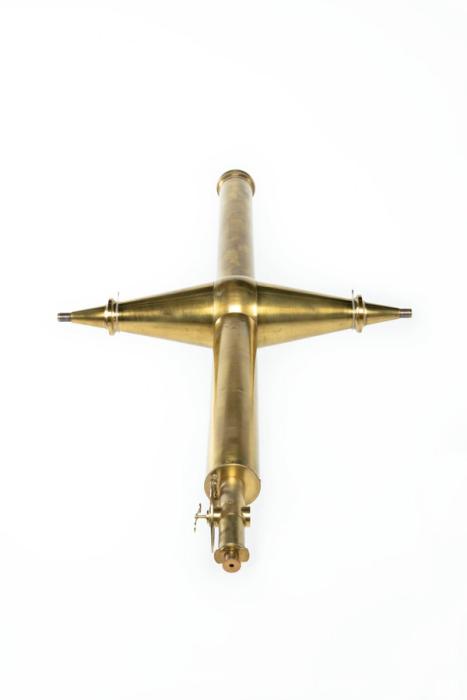
A brass reflecting telescope similar in appearance and optical design to those used by Captain Cook and his astronomer Charles Green at Tahiti to observe the transit of Venus on 3 June 1769. The famous Scottish instrument maker James Short made Cook’s and Green’s telescopes while the English maker Dudley Adams made the one shown here. Courtesy Powerhouse Museum
I have received the following letter from Stuart:
I recently purchased and have just finished reading your book, Transit of Venus 1631 to the Present. I would like to pass on my appreciation for the obvious effort that went into publishing a book of such high quality.
I do have a question if you have some time. On page 74 of your book, the James Short Telescope is noted as a reflector. It looks like a refractor to me.
What is the optical design of this scope, reflector, sct or refractor?
Stuart is right that the James Short telescope illustrated in the Transit of Venus book or the almost identical Dudley Adams telescope shown above do resemble a refracting or lens telescope in that the eyepiece is at the bottom end of the telescope just as in a refractor. This is in contrast to the well-known Newtonian design of a mirror telescope where the viewing point is near the top of the tube at the side.
James Short’s telescopes had a Gregorian design. This design was due to a Scottish mathematician James Gregory who suggested a design for a reflecting telescope in 1663, but was unable to build it himself or get someone else to build it for him. Hence the honour of building the first reflecting telescope went five years later to Isaac Newton, who presented a working model of his own design to the Royal Society in 1668.

A cross-sectional drawing showing light rays inside a Gregorian telescope. Courtesy Wikimedia Commons and ArtMechanic
The Gregorian design due to James Gregory is based on two mirrors: a primary mirror of parabolic shape and a secondary mirror of ellipsoid shape placed after the focus point of the primary to reflect the light back down the tube. There it passes through a small hole at the centre of the primary mirror and is then examined through an eyepiece.
James Gregory has a connection with the transit of Venus in addition to the fact that James Cook used a telescope of his design. In the same 1663 book Optica Promota that Gregory suggests his new reflecting telescope design he also makes the comment in a Scholium to Proposition 87 that
Hoc Problema pulcherrimum habet usum, sed forsan laboriosum, in observationibus Veneris, vel Mercurii particulam Solis obscurantis : ex talibus enim solis parallexis investigari poterit.
Or in English:
This prettiest of problems has a use, but perhaps a very laborious one, in the observations of Venus or Mercury obscuring a little part of the sun : indeed from such the parallax of the sun will be able to be investigated. (Translated by Ian Bruce)
Thus James Gregory did suggest using transits of Venus for solving the problem of the distance of the Sun long before Edmond Halley did in 1716. Halley receives credit as, unlike Gregory, he provided a practical method for making the measurement and not just a hint that transits could be used for the purpose.
James Short was born in Edinburgh, Scotland, in 1710, and was orphaned at age 10. Encouraged by a professor of mathematics, after graduating from Edinburgh University, Short began making reflecting telescopes. The most difficult part in making telescopes was to grind the mirrors of speculum metal and he became much more successful than his contemporaries in giving these mirrors the required parabolic shape. His fame spread quickly and by 1736 he was summoned to London to teach mathematics to William, Duke of Cumberland, who was the younger son of the King and was later to be known as ‘Butcher Cumberland’ after the Battle of Culloden in Scotland. Within two years Short had moved permanently to London, where his telescopes commanded twice the price of those of his competitors.
Short observed the 1761 transit of Venus from London using one of his own telescopes and later as a Fellow of the Royal Society he made a detailed analysis of the various observations by British observers of that transit. Sadly he died in 1768 before the following transit that was observed by James Cook among many others around the globe. It is believed that James Short completed 1370 telescopes in his lifetime.
This blog post is simultaneously published on the Transit of Venus website

One of the two 1874 American Transit of Venus expeditions to Tasmania selected Barrack Square in Hobart as their observing site. A prominent structure on Barrack Square is the 99th Regiment Memorial, erected by the 99th Regiment on Foot to acknowledge regiment members who were killed in the New Zealand war of 1845–47. Photo: Nick-D, Wikimedia Commons
For any transit of Venus observing team an essential task was to determine the longitude of the observing site. This was especially important when the transit observations were to be reduced using the method proposed by the French scientist Joseph-Nicolas Delisle. In this method it was the actual times of contacts at the beginning or end of the transit that had to be compared between observing stations sited around the globe. Knowing the longitude was essential when converting from local time at an observing station to Greenwich Mean Time or another standard time.
Establishing longitude was a difficult task for all observing teams in the 18th and 19th centuries. In the 19th century the task was made easier at many stations by the advent of the electric telegraph. Here we will look at how the telegraph was used to establish the longitude of an American 1874 observing team in Hobart, Tasmania that was led by William Harkness of the US Naval Observatory.

The main buildings of Melbourne Observatory photographed sometime after 1874. Photo courtesy Powerhouse Museum Sydney
The best way to find the longitude was by telegraph from Melbourne, Victoria, Australia. Comparison of time signals between clocks at Melbourne Observatory and at Hobart allowed the time difference between the two places to be found. As this time difference is equivalent to their longitude difference, the longitude of Barrack Square, Hobart was easily obtained by adding the already known longitude of Melbourne. All that remained was to exchange the planned clock signals with Melbourne to determine the longitude of Barrack Square. This exchange was delayed as Professor Harkness had to be on board the USS Swatara while it collected observing parties from New Zealand and Chatham Island. He returned to Hobart on 29 January 1875 to begin the exchange with Melbourne where Edward White was in charge of the operation.
This was the first time that such a telegraphic exchange of clock signals had been attempted using a submarine cable in Australia. This meant that there were many problems to solve before the exchange could proceed. Harkness credits the eventual success of the enterprise to the ‘personal exertions’ and ‘the deep interest’ of the managers of the telegraph in Melbourne and in Hobart as well as the managing engineer of the Tasmanian Cable Company.
Harkness made observations with the ‘broken-tube’ transit telescope to determine the error of his clock. Similarly White observed in Mebourne with the observatory’s transit telescope to determine the error of the Frodsham astronomical regulator clock (an astronomical regulator clock is a highly accurate pendulum clock usually with separate dials for hours, minutes and seconds) that he was using. Time signals were then sent from the Hobart clock to Melbourne so that they could be compared. Similarly, time signals were transmitted from the Frodsham clock to Hobart, again so that the clocks could be compared. Signals were exchanged on seven nights though clouds in Melbourne and in Hobart prevented two of the nights being useful.
With some corrections and a little arithmetic to work out the delay in transmitting the telegraph signal between Melbourne and Hobart, the required longitude could be determined. The transmission delay came to 0.121 seconds. This yields a very low transmission speed of 5376 km per hour, but White notes that, as the delay also incorporates the action of the relays and repeating equipment, the true transmission speed would have been greater.
The final determination of the longitude of the pier in Barrack Square was 147° 20’ 6.9” east of Greenwich. The latitude yielded by Harkness’ previous observations was 42° 53’ 24.6” south. For comparison Google maps yields the very similar values of 147° 19’ east and 42° 53’ 19” south for the position of the 99th Regiment Memorial, which was near the centre of the observing location.
Reference: EJ White, Esq, Account of the Telegraphic Determination of the Difference of Longitude between Melbourne and Hobart Town in the Year 1875, read before the Royal Society of Victoria, 14th December 1876
This blog post is simultaneously published on the Transit of Venus website

The visibility of the 1769 transit of Venus. Map from Transits of Venus by RA Proctor, 1874. Brian Greig collection
In Transit of Venus: 1631 to the present I include a series of wonderful visibility maps of each transit of Venus from 1631 to 2012 that were originally published by the British populariser of astronomy Richard Anthony Proctor in 1874. The maps show where in the world transits are completely visible, where they are visible until sunset, where visible after sunrise or where not visible at all.
There is, however, much more information encoded in the maps. For example, the information on the 1769 map can tell us why Tahiti was such a suitable location for observing that year’s transit of Venus.
Obviously for the transit to be visible at a particular place the Sun has to be above the horizon. What complicates the situation is that transits take a number of hours so that the distribution of day and night on the globe changes from the beginning to the end of the transit. That is indicated on the above map.
On the map the northern hemisphere is on the left and the southern hemisphere is on the right. For the northern hemisphere the distribution of light and darkness at the beginning of the transit moves clockwise to that at the end of the transit. In the southern hemisphere the movement of the shaded area moves anticlockwise. Completely shaded areas indicate regions from where the transit is fully visible and completely dark areas indicate regions from where the transit is not visible at all. From the shaded areas the transit is partially visible either before sunset or after sunrise.

Detail of the visibility map for 1769 transit of Venus showing the region of the South Pacific. The approximate location of Tahiti is indicated by the red circle. Original map from Transits of Venus by RA Proctor, 1874. Brian Greig collection
On the detail from Proctor’s 1769 map note the letters E’, H’ and I’ that denote key locations on the globe for that particular transit. H’ denotes the spot from where the duration of the transit from beginning to end is the shortest from anywhere in the world. That spot is important for the method of durations that had been proposed by Edmond Halley in 1716. In this method the duration of the transit from widely separated locations is compared in order to calculate the distance of the Sun. For the method to give reliable answers the durations have to vary as much as possible and so it was important to make observations from the vicinity of H’.
The point I’ is the spot where the beginning of the transit, ingress, takes place at the latest time while E’ is the spot where the end of the transit or egress takes place at the earliest time. These spots are useful for calculations based on the method suggested by the French astronomer Joseph-Nicolas Delisle in which just one observation of the time of ingress or egress is sufficient to be useful.
As E’, H’and I’ for the 1769 transit all lie near one area of the Pacific, the Astronomer Royal Nevil Maskelyne selected that area to which to send James Cook to make his observations. Fortuitously, the discovery of an island then named King George’s Island in the centre of the area was reported just as Cook joined the Endeavour. Hence Cook and his crew set sail for Tahiti on 25 August 1768.
This blog post will also be published on the Transit of Venus website

The orbits of Venus and the Earth looking from above. Drawing Nick Lomb
Lionel asks:
Congratulations on your Venus book. Excellent.
I notice that there is a 243 year cycle for Transits of Venus
243 x 365.242 = 224.7 x 395
So far so good. The axial rotation period for Venus is 243.1 days.
Is this a coincidence or is there some underlying geometrical fact that I cannot see ?
well-done,
Answer An interesting and complex question that I address below.
Patterns in the transits of Venus
Let us first look at the patterns in the transits of Venus. We need to note that Venus and the Earth line up with the Sun every 583.92 days or 1.59872 years. This is called the synodic period.
If there was a transit, say the one in June 2004, for another transit to occur, the two planets must not only line up with each other and the Sun, but do so after an integer number of years so that they are back in the right places on each of their orbits.
Venus and Earth fulfil these requirements after five synodic periods = 7.9936 years as this is almost, though not quite, equal to the integer eight. Thus transits of Venus generally occur in pairs eight years apart. However, because of the slight inequality there is no third transit after another eight years.
A more accurate relationship occurs after 152 synodic periods = 243.00544 years or ~395 Venus years. The pattern of Venus transits thus repeats at 243 year intervals (This is the cycle quoted by Lionel in his question above). For example, the first pair of June transits after 8 June 2004 begins on 11 June 2247. Of course, in the meantime there is also a pair of December transits beginning in 2117.
The rotation of Venus
Scientists using radar observations from the 1960s onwards discovered that Venus spins backwards, that is in the opposite direction to its motion around the Sun, at the slow rate of 243.02 days.
They soon realised that means that Venus, almost but not quite, shows the same face towards the Earth each time the planets are lined up with each other and the Sun. Somehow there is a resonance between the motion of the Earth around the Sun and Venus’ spin around its axis. Scientists are unsure why this is the case, but one suggestion is that Venus is more massive on the face turned towards the Earth at those times and consequently it was gravitationally captured by the Earth.
How is it worked out that Venus shows the same face towards the Earth each time they line up? The quoted value of 243.02 days is with respect to distant stars. With a little arithmetic (taking inverses) we can easily convert that value to the rotation period with respect to the Sun or, in other words, to the day on Venus. It is 116.75 (Earth) days. Five of those periods equal 583.75 days, which is almost the same as the 583.92 day synodic period. So each time the planets line up Venus shows almost the same face to the Sun and hence the same face to the Earth, which is always on those occasions on the opposite side of Venus.
Coincidence or not
As Lionel points out it is interesting that transits of Venus repeat in a cycle of 243 years while the rotation period of Venus with respect to the stars is 243 days, The above detailed discussion indicates that there is no obvious connection that gives rise to the same number in each case. However, the calculations all depend on many of the same factors such as the orbital periods of Venus and the Earth so maybe there was a chance that the same number should recur.
Note the values quoted above are from the NASA Venus Fact Sheet.
This blog post is simultaneously published on the Transit of Venus website

A sextant built by the English instrument maker Matthew Berge. Courtesy Powerhouse Museum
I have received a letter from Jonathan Milne-Fowler, Lieutenant-Commander RANR (Retired) regarding my book Transit of Venus: 1631 to the present. He says, ‘I’ve just finished reading the book on the Transit of Venus and found it well written and informative. That said I did find a couple of points on which I take issue and have written a commentary’. The two points both refer to Captain Cook’s first voyage that was mainly to view the 1769 transit of Venus from Tahiti. Here I just quote his commentary regarding Cook’s navigation and leave the section on the shape of Cook’s ship the Endeavour to another time.
Determining longitude: A commentary by Jonathan Milne-Fowler, Lieutenant-Commander RANR (Retired)
At page 48 of this book the statement is made that Captain James Cook on his first and most famous voyage (1768-1771), using the method of lunar distances to determine longitude, became the first navigator to know his position at all times. This assertion has been made by other authors but it is erroneous.
There is no doubt that James Cook was one of the few navigators at that time capable of performing the complicated calculations required to determine longitude at sea, but this was always subject to the vagaries of the weather allowing the necessary observations to be made. A bank of fog or cloud in the wrong direction, obscuring the horizon or the sun, moon or stars, may frequently frustrate the intentions of navigators intending to obtain a set of observations for the purpose of determining the position of their ship at sea. More than one hundred years after Captain Cook’s voyages ships supplied with chronometers still came to grief because masters had been unable to take sights needed to calculate latitude and longitude.
Among the first navigators able to determine their position at all times were those embarked in Trident submarines equipped with inertial navigation systems. GPS systems now enable navigators to determine their position with a degree of accuracy which was unimaginable to the likes of Captain Cook.
Lieutenant Commander Milne-Fowler is, of course, correct that saying that Cook knew ‘his position at all times’ is a little exaggerated for he could not make observations during times of bad weather. However, as he was the first to utilise the newly developed method of lunar distances to find the longitude of his ship, he had a better idea of his position than any previous navigator on a major voyage of exploration.
When those previous navigators were sailing to an island they would sail well to its east (or west), sail down a longitude line to the right latitude and then sail west (or east) until they found it. If they had estimated incorrectly and they were on the other side of the island to what they had thought, they would be sailing away and in trouble. In contrast, Cook could sail directly to the location he wanted.
The method he was using to find longitude was the method of lunar distances or lunars. To facilitate the use of this method Cook had with him on his ship the Endeavour Nautical Almanacs, newly published by the Astronomer Royal Nevil Maskelyne. These almanacs listed the angular distance of bright stars from the edge of the Moon at various times at Greenwich.
Cook and subsequent navigators using this method measured the angular distance between a star and the Moon with a sextant together with the elevation of the star and the Moon above the horizon. What made the technique difficult to use was that calculation had to be used to make the measured distance comparable with the tabulated distances.
First the navigator had to make the obvious corrections for the distance between the edge of the Moon and its centre and for the zero or index error of the sextant. Then came the tedious business of ‘clearing the distance’, which was applying corrections for parallax, that is working out what the measured lunar distance would have been if made from the centre of the Earth, and correcting for refraction, the shifts in the positions of the Moon and the star due to the bending of their light by the Earth’s atmosphere.
On his second and third voyages Cook had the benefit of the newly developed chronometers, but on his first voyage Cook’s excellent charts of Tahiti, New Zealand and the east coast of Australia were all due to his skill with lunar distances. He may not have known his position at all times, but he knew it when it mattered.
This blog post is simultaneously published on the Transit of Venus website

HC Russell’s observations at the end of the transit as seen from Sydney Observatory. Photo lithograph from Observations of the Transit of Venus, 9 December, 1874. Powerhouse Museum Research Library
In the previous post I considered the preparations of Henry Chamberlain Russell, the director of Sydney Observatory, for the 1874 transit and the magnificent illustrated book that he published on the event. Here I show a couple of the illustrations from the book.
Russell observed with the new 29-cm or 11½-inch refractor or lens telescope from Hugo Schroeder of Hamburg, Germany. To reduce the heat from the Sun he used an aperture to reduce the main lens to 5 inches (12.5 cm) in width and coloured glass filters in front of and behind the eyepiece. From Sydney the transit began just before local noon and within a few minutes he could see the aureole on the part of the planet still outside the disc of the Sun. He described what he could see as, ‘It was very remarkable and beautiful, like a fringe of green light, through which the faintest tinge of red could be seen’. Since Russell was looking through coloured filters the colours that he describes may not be real.
Four hours later Venus was again at the edge of the Sun prior to egress. In his illustration of the egress Russell presents a sequence of five images with time increasing to the left. Though Russell emphasises that he did not see ‘the black drop’, in the first drawing of the sequence, made just after internal contact, we can see some haziness that is clearly due to similar or the same atmospheric effects as the black drop. Two minutes later the aureole that he called the ‘halo’ was clearly visible on the part of Venus off the Sun. Another 15 minutes later he says, ‘the halo was for the first time seen irregular–in diameter it seemed considerably broader at the north pole of the planet as shown’. For the last few minutes before the planet completely left the Sun, Russell was struggling with poor definition due to approaching clouds, but a white patch could be seen near the north pole of the planet.

Amateur astronomer Mr Alfred Fairfax’s drawing of the aureole through a 4¾-inch (12-cm) lens telescope. The scale of the aureole is greatly exaggerated to allow details to be shown. Photo lithograph from Observations of the Transit of Venus, 9 December, 1874. Powerhouse Museum Research Library
The aureole is due to sunlight refracted through the atmosphere of Venus, but why was there a brightening near the pole of the planet? This went unexplained for 130 years until the 2004 transit. In an article in the Astronomical Journal (141:112 (9pp), 2011 April) Jay M. Pasachoff, Glenn Schneider, and Thomas Widemann indicate that they saw the same effect with the TRACE spacecraft, this time with a brightening near Venus’ south pole. They explain their observations and those of Russell by appealing to previous spacecraft observations of the structure of the planet’s atmosphere. The observations indicate a ring or torus of cold air surrounding each of the poles of the planet that lower the average cloud top height by about 10 km. Extra sunlight can thus stream through regions surrounding the poles of the planet to create the polar spots.
Russell would have been thrilled to have his observations explained. Maybe the 2012 transit will lead to an explanation of those by Mr Fairfax!
This blog post is simultaneously published on the Transit of Venus website

The main Australian observing stations for 1874 transit of Venus. Sketch Nick Lomb
Like the June 2012 transit of Venus, the December 1874 transit was visible in its entirety from Australia. The observatories at Sydney, Melbourne and Adelaide, which are the capitals of the three main states or colonies at the time, made plans to ensure that the rare event was well observed. In addition, there were two United States observing teams in the island state of Tasmania.
In subsequent posts I will discuss the plans and activities at the different places. Here I would like to introduce you to the magnificent book published by Henry Chamberlain Russell, the director of Sydney Observatory, about the 1874 transit observations in 1892. Images from this book are used in almost every book or article published in recent times on the transit. Disappointingly, the images are often not credited or wrongly credited to Charles Potter, the Government Printer, whose name is prominently on the front cover of the book.
In preparation for the transit Russell obtained new instruments including a 29-cm or 11½ -inch refractor or lens telescope from Hugo Schroeder of Hamburg, Germany that is still one of the treasures of Sydney Observatory. He also arranged for three observing stations at country sites to maximise the possibility of obtaining observations if the weather was poor. To staff these extra stations he recruited best scientific men in the Colony including Archibald Liversidge, the newly arrived professor of geology at the local university.

The cover of Henry Chamberlain Russell’s book on the 1874 transit of Venus. Courtesy Powerhouse Museum Library
Immediately after the transit Russell requested all the observers to submit written reports as well as illustrations of their observations. He intended to publish these results as soon as practicable, writing to the Under Secretary of Finance and Trade on 30 January 1875:
The results obtained in New South Wales during the recent Transit of Venus are of the greatest importance, both in a scientific point of view, and also with regard to the credit due to this Colony for the position taken in this important scientific matter.
In order to make the results generally known they must be printed in a first class style, reproducing in the book all drawings photographs &c so far as possible. If this is properly done the work will become known all over the scientific world, and great credit will accrue to this Colony.
Russell goes on to explain that his absence overseas (to report in person to the Astronomer Royal at Greenwich) would not cause undue delay as, in any case, the lithographs would take six months to produce. In the event it took 18 years for the book to be published. Why the long delay? I think that it was the fault of the Government Printer and the manuscript had languished with the printer for most of the 18 years. When I found the originals of the book and its illustrations in the Observatory archives there was a note with them from Russell saying to the printer that the book has been delayed for long enough and to please get on with publishing it.
In the next post we will look at a few of the illustrations from the book and discuss why recently they have been found to provide useful information about the atmosphere of Venus. We will also consider the controversy surrounding the contents of the book.
This blog post is simultaneously published on the Transit of Venus website