

Archive for the ‘Reports’ Category

Book review: Star-Craving Mad by Fred Watson

Published by Nick Lomb on May 1, 2013 No Comments

Fred Watson

Fred Watson celebrating the successful transit of Venus tour at Siding Spring Observatory on 6 June 2012. Photo Nick Lomb

Fred Watson, Star-craving Mad: Tales from a Travelling Astronomer, Allen&Unwin, 2013.

How do you get an author to autograph an e-book? That was my dilemma recently when I had the opportunity to attend one of the many launches of Fred Watson’s new book. After one of Fred’s usual informative and highly entertaining talks the books sold like the proverbial hot cakes with the happy purchasers lining up to get it personally inscribed by the author. I felt left out as I had already bought an e-book version for I had wanted to begin reading it as soon as I could.

The book is certainly worth reading with or without an inscription. Ostensibly it is it about the astronomical tours that Fred has led in recent years, but it ranges over a surprisingly wide gamut of astronomy. Each topic is covered in depth with anecdotes, historical background and then goes into the very latest current understanding of the subject. All of this is told in Fred’s inimitable warm conversational tone that leads the reader to believe that he or she is being personally addressed by the author.

The book starts with an anecdote about a gentleman calling himself Messenger Nine, who interrupted a talk by the author in Berlin. Messenger Nine, surrounded by his followers, claimed to represent Pluto, though surprisingly he did not want to talk about its demotion to dwarf planet status. Instead he made the meaningless prophesy of an earthquake 243° west of the equator. This story will resonate with anyone who has been interested in astronomy for a while for in the audience at a talk there is often a person who wants to harangue the speaker about a pet belief that is totally unrelated to the topic under discussion.

A following chapter is on Pluto’s demotion. However, instead of just discussing the events in Prague in August 2006 at a meeting of the International Astronomical Union that made the decision and which I attended, Fred starts with the lady Venetia Phair, who as an 11-year old suggested the name for the then newly discovered object. Next he relates the various discoveries of other objects in the vicinity of Pluto and beyond that put Pluto’s status into question as well as the recommendations of the two committees set up by the IAU to consider the issue.

A fascinating chapter based on a tour to Peru tells about the various astronomical sights in that country with the most famous of these being the 13 towers of Chankillo. Later we read about the Danish astronomer Tycho Brahe and get the full story of the duel that led to the loss of part of his nose – of all things it related to an astrological prediction about the Sultan of Turkey. The transit of Venus is not forgotten with an emphasis on that brilliant, and sadly short-lived, young Englishman Jeremiah Horrocks. Not only are we told about him, but also about the fate of his friends like William Crabtree and William Gascoigne.

Modern science is not left out. We hear about Einstein’s work on special and general relativity plus about some of his collaborators. We hear about spectroscopy and about Fred’s own area with the wonderful name of galactic archaeology. Here I cannot resist mentioning the image that Fred conjunctures up and quickly demolishes when describing the current idea of the structure of our galaxy: “row of beer-swilling aliens propping up the bar at the centre of a galaxy”.

It is worth buying the book just for the final chapter. This chapter, titled “The Ultimate Journey: Science’s deepest realities”, provides a wide-ranging discussion of the meaning of science. Drawing on his family background, Fred discusses the connections and differences between science and religion. Among other profound questions he asks whether science can provide the degree of comfort that religion gives to the bereaved. Even here the writing has such a light touch that when quantum mechanics is introduced near the end of the chapter and the book, it is introduced in such a diffident manner that I laughed aloud.

Star-craving Mad: Tales from a Travelling Astronomer is highly recommended to anyone, at any level, with an interest in astronomy. If you have not done so already get a copy to read. Just do not get an e-book copy if you want it inscribed by the author!

Piers at Parramatta Observatory_Nick Lomb

The piers of the Jones transit circle in Parramatta Park. Picture Nick Lomb

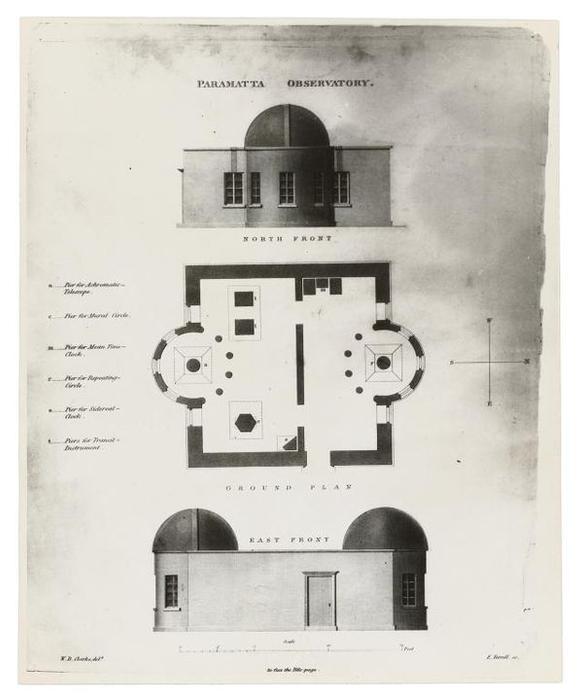
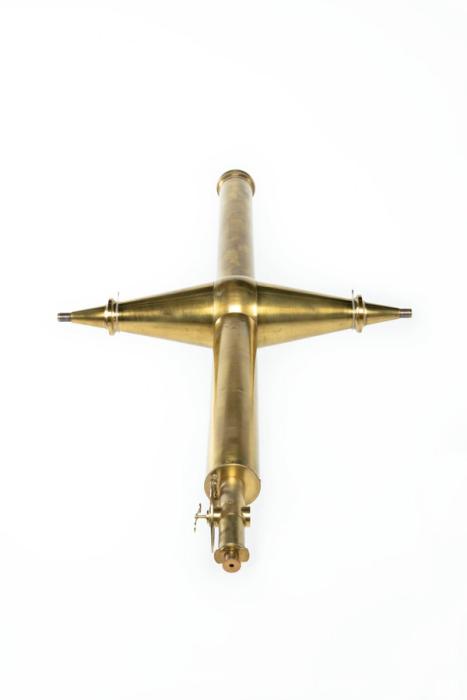
One of the earliest and most important telescopes in Australia’s scientific history is missing and presumed lost. The Powerhouse Museum, of which Sydney Observatory is a part, has most of the main instruments that were used at the historic early 19th century Parramatta Observatory, but some are missing including the Jones transit circle.

A transit telescope or a transit circle was at the heart of every 19th century observatory. The first of these is a telescope set up so that it can only swing in the north-south direction. Astronomers use it to determine the exact instant that stars cross the imaginary line passing north-south and overhead called the meridian. If the position of a star is known the observation will determine the time, while if the time is known the observation determines one of the two coordinates giving the position of the star, the one equivalent to longitude on Earth, called the right ascension. Finally, if both the time and the star’s position are known the observation gives the longitude of the observatory.

Radcliffe Circle_Oxford_Nick Lomb

The Radcliffe Circle from Radcliffe Observatory is at the Museum of the History of Science at Oxford. Also built by Thomas Jones, it has a date of 1836 so it was built more or less at the same time as the Parramatta instrument and is likely to have been very similar. Photo Nick Lomb

A transit circle is a more sophisticated version of a transit telescope for it has a graduated circle. This addition allows the astronomers to also determine the second coordinate of a star’s position, the one equivalent to latitude on Earth, called declination.

When Parramatta Observatory first began operating at its position near Government House, Parramatta in 1822 it had a simpler transit telescope by the English maker Edward Troughton – this is on display at Sydney Observatory. Later a more sophisticated transit circle was ordered from London instrument maker Thomas Jones. This arrived at Parramatta in 1835 and the sole astronomer at the time John Dunlop replaced the original transit telescope with the new instrument. He first used it on 28 April that year, but soon found it ‘as being so very unsatisfactory in its fittings and graduation of the Circle as to be quite useless.’

Parramatta Observatory closed down in 1847 and was demolished soon afterwards. The stone piers for the Jones transit circle were left as the only visible remnants of the historic observatory remaining in Parramatta Park.

Jones transit circle_Scott 1859

A view of the Jones transit circle installed at Sydney Observatory. The vertical bars in front of the telescope tube represent a side view of the large graduated circle. Note the asymmetric placement of the telescope on the conical axis that is also visible on the Radcliffe Circle pictured above. Drawing from William Scott’s ‘Astronomical Observations made at the Sydney Observatory in the Year 1859 (Powerhouse Museum Research Library)

The remaining instruments from Parramatta Observatory were put into storage and eventually transferred to Sydney Observatory when it was established in 1858. The transit circle was an exception though for following Dunlop’s poor assessment it was first sent to England for repair. It finally reached Sydney Observatory at the end of December 1858, but it took the Government Astronomer Rev. William Scott another five months to arrange for the quarrying and preparation of the required stone piers.

The Jones transit circle was used at Sydney Observatory for almost two decades. When Henry Chamberlain Russell the then Government Astronomer replaced it with a more modern instrument the piers were exiled to the grounds of the Observatory where they still stand. The instrument itself is believed to have been lent to Sydney University in the early 1900s and it seems never returned.

If anyone reads this post from the School of Physics or maybe the School of Geosciences at Sydney University please keep an eye out for this historic instrument whenever visiting storage rooms with dusty and cobwebbed old instruments. I suspect that my colleagues and I will be so pleased to see it that any late fees on the loan will be waived!

Sydney Observatory in the early 1980s_the basement

Published by Nick Lomb on April 3, 2013 2 Comments

The basement about 1982_facing south_Nick Lomb

Looking south in Sydney Observatory’s basement in about late 1982. Photo Nick Lomb

in July 1982, when Sydney Observatory came under the auspices of the Powerhouse Museum, it looked very different to what it does today. Here are a couple of pictures of the Observatory’s basement before the changes brought about by the Observatory’s new role began in earnest.

In the early 1980s the Observatory’s basement was a magical place housing lots of clocks and related devices that could be both heard and seen. Evening and Wednesday afternoon visitors were taken there to look at two large models – one showed the planets circling the Sun while the other was a model of the Earth and the Moon circling the Sun. Visitors were fascinated by these devices as it is so much easier to understand these motions including the seasons, phases of the Moon and eclipses when looking at three-dimensional models.

In the above photograph the Sun, Earth, Moon model (tellurium) is in the foreground. It was built in the Observatory’s workshop in 1952 and though no longer on display, it remains in the collection of the Powerhouse Museum.

Against the back wall we can see the Shortt 49 slave clock. The Shortt clocks were the most accurate mechanical clocks ever made with a daily accuracy of about 0.01 seconds. They consisted of a master clock, in which the pendulum oscillated in a vacuum, and a slave clock, the pendulum of which was corrected every 30 seconds by the master clock. Sydney Observatory had two of these clocks with both slaves on show in the basement, while the masters were in a separate temperature-controlled room. Incidentally, in those low tech and low budget times, the temperature control consisted of a continuously switched on electric bar heater that had been rewired for low wattage.

The old refrigerator next to the slave clock was used not to store beer or other beverages for the astronomers, but the photographic plates used for photographing the sky. The plates needed to be kept cold before they were exposed.

The boxes on the left housed equipment relating to the clocks. The box at the end was internally lit and had a glass top so that visitors could see the relays that sent out the six-dot signal or the ‘pips’ to radio stations on the hour. The clock that controlled these relays was an atomic clock housed upstairs, but the mechanical clocks in the basement were kept going as part of a complex backup system. On rare occasions the pips were not sent out and immediately the radio stations called and complained. The problem was usually due to a telephone line failure.

The basement about 1982_facing north_Nick Lomb

Looking north in Sydney Observatory’s basement in about late 1982. Photo Nick Lomb

In the photo above we are looking in the opposite direction and we have a better view of the planet model or orrery that showed the relative rates that the planets move around the Sun, which was represented by an incandescent light globe.

The poor state of the painting on the ceiling is rather obvious. The story was that the Observatory had been hurriedly painted for the 1973 General Assembly of the International Astronomical Union that was held in Sydney with the Government Astronomer Harley Wood as the chair of its organising committee. Somehow the painters made such a mess of the basement ceiling that the paint peeled off soon afterwards.

The room at the end of the basement with light escaping through the glass panel in its door was the temperature-controlled room that housed the two Shortt free-pendulum master clocks. Just to the left of the door with the glass panel is a small dark room used to develop the photographs of the sky taken with the Observatory’s astrographic telescope and its attached camera.

Today, the basement, also known as the Discovery Room, is a lecture room used for adult education classes and by the Sydney City Skywatchers for their monthly meetings. If you have not been to the basement, come along on the first Monday of each month at 6:30pm to a meeting of the Skywatchers. All are welcome and there is only a token payment of $2 requested for supper and a raffle ticket.

Can an Iridium flare be brighter than the Moon?

Published by Nick Lomb on March 20, 2013 No Comments

Full Moon_6 May 2012_Nick Lomb

The full Moon. Photo Nick Lomb

A question from my Sydney Observatory colleague Allan:

Most sources have the Moon as apparent magnitude -12.74 (or -12.92) and iridium flares are listed as max -9.5. However, as the flare is point source while the Moon’s light is from a diffuse area, is the flare actually brighter to the eye?

Answer:

Yes, the listed apparent brightness of the Moon refers to the total light that comes from its disc. If we look at a small segment of the Moon there would be less light coming from it and its magnitude would be less.

An Iridium flare is a reflection of sunlight from an Iridium satellite towards us on the ground. If everything is lined up perfectly so that the satellite reflects the sunlight straight towards us the brightness is equivalent to a magnitude of -9.5, which is much brighter than the maximum brightness of the planet Venus.

As Allan says, an Iridium flare appears like a point source to us. Now our unaided eyes can resolve an angle of about one minute of arc, so we can take the brightness of the flash as spread over a box in the sky with sides of width one arc minute.

For comparison, into how many such boxes could we divide the full Moon? Taking the width of the full Moon from Earth as 30 minutes of arc and noting that area is given by the formula πr² where r is the radius, we find the area of the full Moon as 707 square arc minutes or 707 resolvable spots.

As magnitude is a logarithmic scale we need to find the magnitude of one resolvable spot on the Moon using the formula

m1 – m2 = -2.5 log (I1/I2) where m is magnitude and I is intensity.

Taking m1 as the magnitude given for the full Moon by Allan as -12.74 and the intensity ratio as 707 we find that the smallest resolvable spot on the Moon has a magnitude of -5.6.

Thus we can say that the average surface brightness of the full Moon per square arc minute is -5.6 which is much fainter than the maximum -9.5 brightness of an Iridium flare. Hence we can regard an Iridium flare as the brighter!

Thanks Allan for an interesting question.

2013Feb20_ejn_3views

Three views of an ejected prominence at the edge of the Sun on 20 February 2013. Sketch and copyright Harry Roberts ©, all rights reserved

Filaments (aka prominences) are large aggregations of ionised material that occur on the sun where surface fields of opposite ‘sign’ abut. There are two kinds: quiet region filaments and active region filaments, both occur in either hemisphere.

Active region filaments associate closely with sunspot groups, and often thread between the spots in a group– the product of fields >±100 gauss or so.

Quiet region filaments haunt the ‘quiet’ parts of the sun and may be found anywhere, from the sunspot latitudes to the polar regions. These filaments can grow thick and at times very long – they are the product of much weaker fields, the remnant fields of ‘decayed’ spot groups. These relic fields are seen in full disc magnetograms, with a field strength of ~±5 gauss (Zirin, H. “Astrophysics of the Sun”. Cambridge Uni. Press, 1986, P. 276).

Prominence fields. I’ve often wondered how the weak ‘quiet region’ fields can create the huge long-lived filaments. Bray and Loughhead noted that the magnetograms only show line-of-sight (longitudinal) fields – not the transverse fields that ‘fence-in’ the filaments. Looking down on a filament there is no sign of the transverse fields that confine it, fields that run in opposite directions along the filament’s ‘channel’. Perhaps transverse fields are much stronger than we think.

Prominence ejection. Australian heliophysicist Ron Giovanelli described them as: “Rather like the snake that sloughs off its skin to grow, prominences pass through the occasional traumas of eruptions during which they blow off from the sun in the course of a few hours” (“Secrets of the Sun”. Cambridge Uni. Press, 1984, P. 93). ‘Hal’ Zirin warns that any filament (i.e. prominence) greater than 50Mm in height will erupt within 48 hours (“Astrophysics of the Sun”. Cambridge Uni. Press, 1986, P. 276).

On February 20th most attention was on the flaring in AR11678, however, the sun also hosted a fine prominence ejection about the same time.

At 21:14 a tall prominence was logged at the SW limb, already 58Mm in height – and slowly rising above the limb, still linked by a strand to the surface at –5,106 (i.e. lat. 5ºS, long. 106º) at its northern end.

It showed the typical arched lower edges, points of recent detachment perhaps – above which, irregular fine structures interwove at their upper ends: the whole thing fairly bright due to the turbulence of ejection.

When next logged at 21:35 the prominence was 85Mm above the limb, much fainter and somewhat expanded – it now had simpler internal structures, perhaps the result of falling temperatures and declining fields.

Fifteen minutes later the cooling prominence, now 105Mm high, had faded to smoke-like wisps: wisps that stretched some ~120Mm in length. Although the surrounding corona is over 1,000,000K at this altitude, it does not heat the prominence much, as Zirin explains (“Astrophysics of the Sun”. Cambridge Uni. Press, 1986, P. 276)

While such numbers seem huge – it was not an unusually large ejection. My logs show no previous filament at the site but clearly there was one. When quiet filaments erupt we may see a Hyder flare – but none was logged. Currently, filaments are hard to see: as are sunspots; weaker core fields are the likely cause and filament fields are only1/300th those of spots. .

Ejection velocity. The logs showed this ejection was a sedate 25km/sec– typical of a quiet region filament. Their active region ‘cousins’ can, however, exceed 2000km/sec under special circumstances.

While seeming to lead quiet lives on the disc, when filaments decide to erupt, they can become both exciting and beautiful events to witness.

Harry Roberts is a Sun and Moon observer, a regular contributor to the Sydney Observatory blog and a member of the Sydney City Skywatchers.

Soviet celestial globe

Celestial globe made for navigation shows accurate positions of bright stars. Courtesy Powerhouse Museum

Stars spread out in all directions from us and are at very different distances. However, to define the positions of stars and other bodies in space astronomers regard the sky as lying on a giant sphere called the celestial sphere. On this sphere there is a coordinate system similar to the system of longitude and latitude on Earth. The celestial equivalent of longitude is called right ascension, which is usually measured in hours, minutes and seconds, while the equivalent of latitude is called declination, which is measured in degrees north or south of the equator.

It is relatively easy to plot star positions on a sphere to form a celestial globe. Such globes show the positions of stars and their relative distances and angles from each other accurately. However, when my colleagues and I would like to indicate to readers of this blog the position of a comet or other object of interest in the sky it is only possible to show this on a flat surface. Similarly, published star maps and those produced by computer programs and apps all have to output their maps on a flat surface.

equal area_cylindrical_perspective

The area around the south pole in the sky with the Southern Cross and the Pointers on the left or east and the bright star Achernar on the right or west. The distortions using three different projections are shown: equal-area, cylindrical and perspective. Illustration Nick Lomb using Stellarium software

To achieve a star map the spherical celestial surface has to be projected on to a flat surface. The same techniques can be used for this purpose as have been developed over thousands of years to map the Earth. There are a large numbers of ways of putting a sphere on a flat surface with each having its advantages and disadvantages. Some methods preserve angles between objects, others preserve the area of particular regions while in others the scale is constant along one direction though not in others. There is some distortion in all methods and an appropriate method has to be chosen in each case.

An example is the perspective or gnomic projection. In this technique one hemisphere of the sky is projected on to a flat plane that is tangent to it with the projection point being the centre of the Earth. The advantage of this method is that great circles – the shortest distances between two points on the celestial sphere – map as straight lines. The disadvantage is that there is severe distortion in shape, area and direction.

Another example is equal-area projection, one version of which glories in the name ‘Lambert azimuthal equal-area projection’, in which the areas of regions in the sky such as constellations are preserved. Directions from the poles are also maintained but the scale changes as the distance from the pole increases.

A final example is cylindrical equidistant projection. This is a simple projection of a sphere onto a tangent cylinder which is then unwrapped. It is possible to arrange the projection such that the scale remains constant along all parallels, that is lines of constant declination, so that there is no distortion in the east-west direction. Of course, there are changes of scale or distortions along the north-south direction.

Unfortunately, all star maps on a flat surface necessarily distort the view of the sky in some way. In each case the person producing the map has to decide on the best compromise for the particular purpose for which the map is drawn or the particular purposes for which a computer program or app is likely to be used. Maybe in the near future we will all have pocket projectors that will be able to produce star maps on virtual spheres, but as yet these do not exist.

Reference Richard Kippers of the Faculty of Geo-Information Science and Earth Observation at the University of Twente in the Netherlands provides an excellent discussion with illustrations of various map projections here.

An early photo from Sydney Observatory of Comet Swift 1892

Published by Nick Lomb on February 28, 2013 No Comments

Comet Swift 1892_Sydney Observatory

A drawing of Comet Swift 1892 based on a photograph taken at Sydney Observatory on the early morning of 22 March 1892. The drawing is by Richard Pickering Sellors while the original photograph was taken by James Short. Courtesy Powerhouse Museum

Henry Chamberlain Russell, the Government Astronomer at Sydney Observatory, received a telegram indicating the discovery of a new comet on 9 March 1892. The discoverer was 72-year old Dr Lewis Swift of the Warner Observatory at Rochester, New York State, who had nine previous comet discoveries to his credit. This new comet was to become famous because of the rapidly changing appearance of its tail. Photographs taken in early April by two well-known American astronomers EE Barnard of Lick Observatory and WH Pickering of Mt Wilson Observatory, but observing from Peru, are usually credited with showing the phenomenon. However, Russell had both photographed and documented it earlier.

Clouds did not permit observations of the comet until the morning of 11 March when a 1 hour 50 minute exposure was made of the comet with the ‘star camera’. In his report to the Royal Astronomical Society in London Russell says that as the photograph was taken through thin cloud and bright moonlight (the waxing gibbous moon was two days from full) the comet’s tail appears fairly faint. Still five ‘equidistant rays’ could be seen spread over an arc of 25°.

The next opportunity to see the comet was 11 days later, on the morning of 22 March, when the Observatory’s photographer James Short took an exposure of 2 hours 23 minutes though with clouds intervening for almost half an hour. This time the photograph shows eight separate rays in the tail, while according to Russell one of the original rays has now detached itself from the head of the comet and is not ‘visibly joined to it’. As on the previous occasion, the tail could not be seen through the 11½-inch telescope (still used in the south dome of the Observatory, but now called the 29-cm telescope) except as ‘a slight hazy extension’.

To accompany his report to the Royal Astronomical Society, Russell had one of his staff, Richard Sellors, make an enlarged drawing of the original negative. Sellors could easily do this as the photograph had the standard grid or reseau that was used with the Observatory’s major star cataloguing project, the Astrographic Catalogue.

Comet Swift_EE Barnard_4 and 6 April 1892

Swift’s Comet photographed on 4 April 1892 (top) and 6 April 1892 (bottom) by Professor EE Barnard. The images are on Plate IV in A Popular History of Astronomy in the nineteenth century by Agnes M Clerke (third edition). Courtesy archives.org

Agnes Clerke in her Popular History of Astronomy in the nineteenth century says that Swift’s 1892 comet was the brightest comet that people in the northern hemisphere had seen for ten years. It was brightest about the time of its closest approach to the Sun on April 6. Then the head of the comet was of third magnitude (same as the predicted brightness of Comet PANSTARRS in March 2013).

In describing the tail of the comet Clerke refers to the photographs by EE Barnard and WH Pickering, claiming that they ‘marked a noteworthy advance in cometary photography’. The description based on that of Barnard is rather flowery: ‘The middle portion of the tail is brighter and looks like crumpled silk in places’. And ‘The next morning the southern was the prominent branch…with a strange excrescence, suggesting the budding-out of a fresh comet in that incongruous situation’.

Despite the flowery descriptions from the American Barnard, I cannot feeling that if Henry Chamberlain Russell had not been in distant, far-away Australia, then the photographs of Comet Swift taken under his direction would be the ones that would be the best known.

How often do asteroids strike the Earth_part two?

Published by Nick Lomb on February 20, 2013 No Comments

tunguska_kulik

Trees uprooted by the 1908 asteroid impact at Tunguska. Courtesy NASA and the Leonid Kulik expedition

In part one of this post we looked at a few recent small asteroid impacts on Earth such as one over an Indonesian town in October 2009 by a 5 to 10-metre asteroid and one over the Nubian Desert in Sudan a year earlier by an asteroid with a width of about 4-metre.

The famous Tunguska impact of 1908 was somewhat larger than these. On the morning of 30 June that year an asteroid of about 40-metre width entered the Earth’s atmosphere near the Tunguska River in Siberia. Like in the February 2013 event above the town of Chelyabinsk the rock exploded causing fast shock or pressure waves on the ground. The locals though it was the act of an avenging god and there was no scientific investigation for 19 years. In 1927 Leonid Kulik of the St Petersburg museum reached the area on his second attempt with an expedition. Kulik and his team found a large area with uprooted trees lying radially away from the spot below the explosion. It has been estimated that 80 million trees had been uprooted by the impact.

The last impact that we know of that had serious world-wide consequences was the one over the Yucatán Peninsula of Mexico 65 million years ago. That impact by an asteroid of at least 10-km width led to forest fires all over the globe. This was likely followed by a period of cold temperatures due to dust and smoke blocking sunlight and then high temperatures due to the release of carbon dioxide into the atmosphere. These effects were devastating to the dominant animal species on the planet at the time, the dinosaurs, but they provided an opportunity for other animals such as the mammals to become widespread and to evolve into the variety of species that we know today such as dogs, elephants and humans.

By studying past impacts scientists hope to answer the question of how often they take place. Obviously and fortunately, impacts by smaller asteroids are more common than by larger ones. Hence scientists are trying to establish the rate of impacts or the average time between impacts by asteroids of different sizes. It turns out to be a difficult question to answer with a range of answers coming from different studies.

There are a number of ways of approaching the question. One is to look at the 1400 or so Potentially Hazardous Asteroids that have been found so far. From their brightness, which is observable, their size can be estimated and from the size their mass. Further estimates and calculations then are made to derive the energy with which they hit the atmosphere and what fraction of the energy actually reaches the ground. According to a 2011 paper by John Tonry of the University of Hawaii in the Publications of the Astronomical Society of the Pacific these kind of calculations suggest that the rate of impacts by asteroids 140-metres or larger is one per 20,000 years, for asteroids of Tunguska size one per 1000 years and the rate of 10-metre asteroids is one per decade.

David Asher of Armagh Observatory and colleagues take another approach in a paper published in The Observatory. In their calculations they take into account events like the predicted close pass of the 250-metre wide asteroid Apophis on the morning of 14 April 2029. They also look at the number of meteorites from the Moon found on Earth as these were ejected by impacts on the Moon by Tungaska-sized or larger asteroids. Their results suggest an impact rate of asteroids of the size of Apophis or larger as one every 3000 years while a Tunguska-sized impact could occur every 300 years or less.

These figures, together with recent events, suggest that governments do have to take the possibility of asteroid impacts seriously. In the United States NASA and other organisations do an excellent job in searching for PHAs and most of the larger, and hence more dangerous, ones have been found. There is also a search program at Siding Spring Observatory in Australia, but sadly it only receives small and sporadic funding.

For individuals though, the threat of being hurt in an asteroid impact is very tiny and much less than the threat of car accidents and other more mundane day-to-day occurrences. There maybe plenty of good reasons to look up into the sky, but looking out for an exploding asteroid is not one of them!

How often do asteroids strike the Earth_part one?

Published by Nick Lomb on February 19, 2013 No Comments

PIA00118_modest_Gaspra

The asteroid 951 Gaspra has a maximum dimension of 19 km. An impact by an asteroid of such a size would have a disastrous global impact. Image courtesy NASA

Asteroids have been in the news in February 2013. On Friday 14 February an asteroid believed to be about 17-metre in width and a mass of about 10,000 tons hit the Earth’s atmosphere at a velocity of over 50,000 km per hour. It hit over the Russian town of Chelyabinsk and exploded with blast waves that shattered windows all over the town. A 1000 or so people were injured. The following morning asteroid 2012 DA14 of about 50 metres size that had been discovered a year earlier passed the Earth harmlessly, but at a worryingly close distance to the surface that was less than that of the ring of communication satellites.

Where do such objects come from? How often do they hit the Earth? Should we be worried?

Asteroids are rocky or metallic objects independently circling the Sun. They range in size from a few hundred kilometres to a metre or so across. Most of them circle the Sun between the paths of the planets Mars and Jupiter. This region is known as the asteroid belt and scientists believe that the huge number of objects there represent the remnants of a planet that could not form due to the gravitational influence of the giant planet Jupiter.

The asteroid belt is not a nice ordered place with police personnel controlling smooth motion around the Sun. Instead there is the occasional collision that breaks large asteroids into smaller pieces and sends them out of the belt. Some of these ejected pieces take up paths that can intersect with that of the Earth. These are the Potentially Hazardous Asteroids or PHAs.

The Earth is regularly hit by such objects, although fortunately impacts by large objects are much less common than impacts by smaller objects. A recent impact was that of a 5 to 10-metre object that exploded over the town of Bone in Indonesia on 8 October 2009. No one was injured and initially the local authorities took it to be a plane crash or an earthquake. However, the impact and subsequent explosion were detected by the stations around the world that listen out for illegal nuclear explosions. Scientists could then use the data from those stations to work out exactly what had taken place.

A year before the Indonesian impact, there was one over an isolated area of the Nubian Desert in Sudan. Interestingly, that small object of about 4-metre width was detected a few hours earlier on 6 October 2008 and the impact area calculated and publicised in advance. Sometime after the impact a scientist from the University of Khartoum went to the impact site with a group of students and recovered 280 meteorites – pieces of the original asteroid. To researchers these pieces were invaluable as it was the first time that they had materials from an asteroid with a known path (prior to impact) around the Sun.

To be continued…

Return from Ridge A
s20130119-stringy small

s20130118-geoLandscape2 small

We have recently returned from 6 days / 5 nights camping on the high Antarctic plateau at a place known as Ridge A: the driest and possibly coldest place on Earth. Our mission was to refuel and refurbish an existing robotic observatory (the Plateau Observatory; PLATO), which supplies power and communications to a 0.6 m terahertz telescope (the High Elevation Antarctic Terahertz telescope; HEAT).

s20130117-platoR small
After around a week of weather delays at the South Pole, our Twin Otter pilots were finally given the go-ahead to fly us to this remote location. Although 25 knot winds were forecast, the previous week’s experience had shown us that the winds were typically overestimated, and hence this was not considered to pose any threat.

Around 4 hours after departing the South Pole, we landed at Ridge A. It turns out that the weather forecasts were spot on: -40 degrees C and 20-25 knot winds. If you believe in the “windchill factor”, this pushes temperatures down to near -60 degrees C. A preliminary review of data from an automated weather station at nearby Dome A suggests that this may possibly be the worst (windiest) weather in recorded history! Just our luck.

s20130118-selfiePlatoRsmall
After ripping apart some failed electronic components from the modules (which were sent back via the same Twin Otter to the South Pole for repair), we quickly went into “survival mode”, huddling around in a tent with hot drinks provided to us by our mountaineer/guide.

For the remainder of our time at Ridge A, the winds died down but were still stronger than usual, making work a lot harder than anticipated. Thankfully, we had two large “work tents” designed to shield us from the wind and perhaps even provide a (relatively) warm work environment. The temperatures at Ridge A varied from approximately -45 C at local midnight, to -35 C at local midday (keep in mind the Sun never sets). A few hours after local midday, our tent was usually around freezing (0 degrees C), which meant we could comfortably work in just thin glove liners.
s20130120-batteries small

We were only meant to spend a couple of nights in the field, but once again weather delays meant we were trapped at Ridge A for much longer than anticipated. Although the extra time was utilised (and in fact proved to be a blessing given the harsh working conditions), nothing can describe the relief we felt on the 6th day when we received word that a Twin Otter was on its way to take us home. The same aircraft would deploy the remainder of our team in the field in a “tag team” like fashion..

I am writing this blog entry from the South Pole, where -25 degrees C has never felt so warm. The past 6 weeks in Antarctica has been an incredible experience. We have slept in an igloo at the foot of an active volcano; watched seals and penguins dance on the ice; spent a couple of weeks at the geographic South Pole; and of course camped at the driest, coldest, and one of the most remote and inhospitable places on Earth: Ridge A. The last of our team are due to return from the Ridge A campsite later tonight. We will all begin the journey back to Sydney tomorrow.

Detailed daily accounts of our adventures as well as view many more photographs and time lapse videos, are available for viewing at our blog.

Geoff

(Geoff is one the wonderful casual staff that work at the Observatory while he is completing his Ph.D)

About

The 'Observations' blog is run by the staff of Sydney Observatory which is located at Observatory Hill, The Rocks, in Sydney, Australia.

This site is for discussion purposes only and does not represent the official views of Sydney Observatory. Any views expressed on this website are those of the individual post author only. Sydney Observatory accepts no liability for the content of this site.

Please direct any correspondence about the content of the blog to:
observatory [at] phm.gov.au
and about web matters to:
web [at] phm.gov.au.

Search