



Archive for the ‘Sky information’ Category

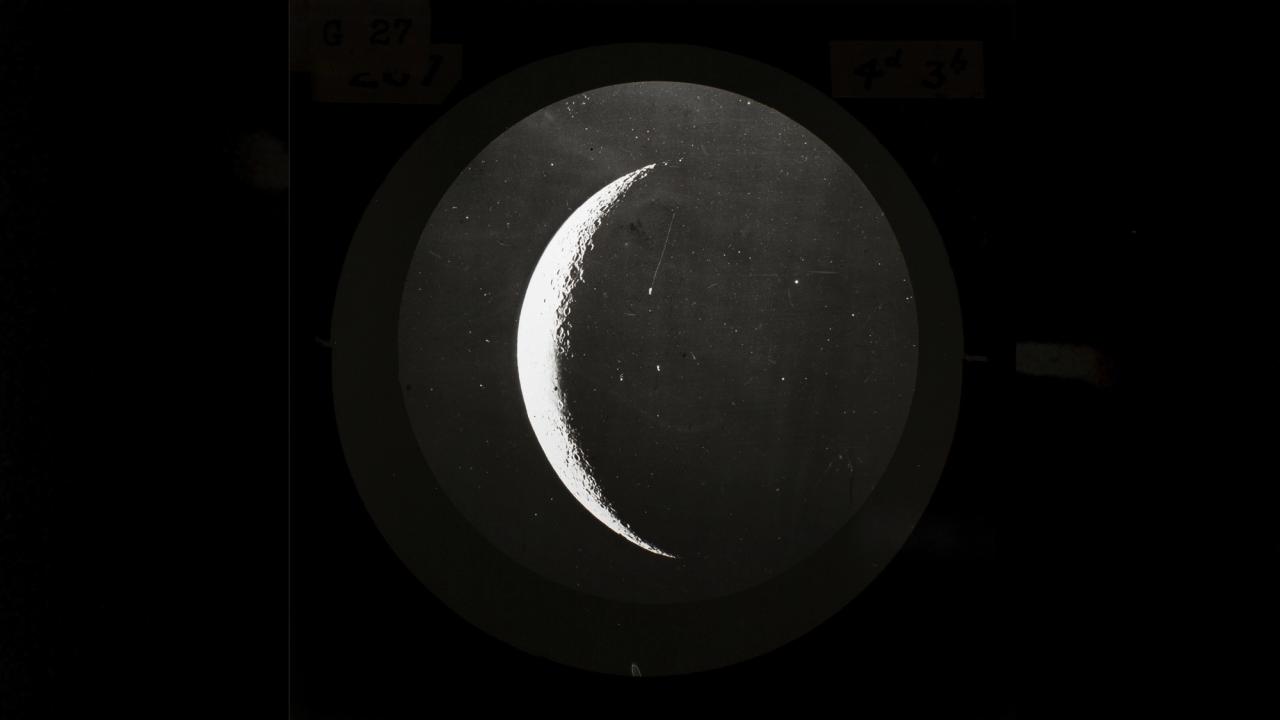
The crescent Moon at dusk_Nick Lomb

A crescent Moon at dusk. Image Nick Lomb

The first visibility of the crescent Moon after the astronomical instant of new Moon is not only of interest to astronomers, but is of particular significance in the Islamic calendar. The crescent Moon is always first visible after sunset. For it to be visible the Moon has to have moved away from the glare of the Sun and it has to be suitably high above the horizon at sunset so that there is time for the sky to become sufficiently dark before moonset.

A number of methods of predicting the visibility of the crescent Moon have been developed over the years.

The simplest useful criterion is the lagtime between sunset and moonset. If that time is greater than 47 minutes (at the latitude of Sydney) the crescent Moon should be visible to the unaided eye after sunset and before the setting of the Moon.

The most common method of prediction is to use a scheme developed by Dr Bernard Yallop of HM Nautical Office and proposed in 1997. This scheme or algorithm involves the altitude difference between the Sun and the Moon at a calculated ‘best time’ to view the Moon plus the width of the crescent.

In 2013 the important Islamic month of Ramadan begins after the new Moon of 8 July. This occurs at 5:14 pm AEST. When is the crescent Moon visible from Sydney? There is no possibility of it being seen on the evening it is new.

On Tuesday 9 July 2013 sunset in Sydney is at 5:01 pm while moonset is at 6:00 pm, giving a lagtime of 59 minutes, which indicates that the crescent Moon should be easily seen from Sydney and the rest of Australia.

Global maps of predicted visibility are available here.

The month of Shawwal begins with the first visibility of the crescent Moon after the new Moon of 7 August 2013, which occurs at 7:51 am AEST.

On Wednesday 7 August 2013 sunset in Sydney is at 5:20 pm while moonset is at 5:45 pm. This gives a lagtime of only 25 minutes, which is too short for visibility. This is confirmed both by the program MoonCalc 6.0 using the Yallop criterion and the global visibility map for 7 August 2013.

On Thursday 8 August 2013 sunset is at 5:20 pm while moonset is at 6:41 pm. With a lagtime of 1 hour 21 minutes the crescent Moon will be easily visible from Sydney and elsewhere in Australia.

Planet Dance 26 to 31 May 2013

Published by Nick Lomb on May 21, 2013 1 Comment

anigif_planets_May 2013

The changing aspect of the planets Jupiter, Venus and Mercury close to the north-west horizon from 26 to 31 May 2013 as seen from Sydney at 5:45 pm each evening. Animated GIF compiled by Nick Lomb using Stellarium

At the end of May the two brightest planets Venus and Jupiter are approaching each other in the evening sky and are joined by the elusive planet Mercury. Over a period of a few evenings they take on a variety of close configurations that gives a spectacular view and a great demonstration of the movement of the planets.

Each evening during that period has its interesting aspect, but the two bright planets, Venus and Jupiter are the closest on the evenings of 28 and 29 May. During those evenings the separation between them is just over one degree or two moon-widths.

Unfortunately, this ‘planet dance’ takes place during twilight and very close to the north-west horizon. Those who would like to view the planetary alignment need to find a location that gives a good view of the north-west horizon clear of houses, trees and other blockages to the line of sight.

Venus should be visible to the unaided eye from the start of civil twilight, which is about half an hour after sunset. Binoculars should make Jupiter and Venus visible as well. Remember, do not search for the planets with binoculars before sunset as you could do serious damage to your eyes! After civil twilight Jupiter and Mercury start becoming visible to the unaided eye as well, but disappear or are about to disappear below the horizon just as it becomes dark enough to see them clearly.

Planet positions 28 May 2013

The position of the planets on 28 May 2013 shown in an oblique view from above the south pole of the Sun. Motion of the planets is anti-clockwise. Diagram Nick Lomb

Although the three planets appear close together in the sky, they are separated by large distances. Their apparent closeness is purely a line of sight effect. Their aspect changes so quickly from evening to evening because the two planets closest to the Sun, Mercury and Venus move very rapidly. On the diagram above, they move to the left while our observing platform, the Earth, moves to the right. Over such a small period Jupiter can be regarded as stationary since it takes 12 years to circle the Sun; during one stately Jupiter year Mercury has darted around the Sun almost 50 times.

Enjoy the dance!

Jupiter_30 January 2013_IMG_1854

Jupiter and its four Galilean moons on the evening of 30 January 2013. Europa is on the left, Io is too close to the planet to see, then Ganymede and, finally, on the right Callisto.Picture Nick Lomb

Currently, the bright planet Jupiter is prominent each evening in the northern sky. On the night of Monday 18 February, as seen from Sydney, the first quarter Moon will be gliding past Jupiter around midnight. The sight will be worth staying up for, with the separation between edge of the Moon and the planet only about three minutes of arc – this angular distance is equivalent to only about a tenth of the Moon’s width.

Start occultation_Melbourne_11_25pm

The dark edge of the Moon about to start covering Jupiter and its four Galilean moons at 11:25 pm on 18 February 2013. Diagram Nick Lomb using Stellarium software

However good the sight will be from Sydney, it will be better from places such as Melbourne, Hobart, Adelaide and Perth where onlookers will see the Moon actually cover or occult Jupiter. In those places people with a small telescope will not only see the planet itself disappear, but over a period of about 20 minutes see its four Galilean moons covered one at a time. And a little later, over a period of about ten minutes, Jupiter and its four moons will reappear at the bright edge of the Moon.

End occultation_Melbourne_12_17am

The end of the occultation with Jupiter and its four Galilean moons reappearing from behind the Moon as seen from Melbourne at 12:17 am on 19 February 2013. Diagram Nick Lomb using Stellarium software

Times for the disappearance and reappearance of Jupiter from a few state capitals on the evening of Monday 18 February and the morning of Tuesday 19 February 2013:

Place…….Disappearance……..Appearance
Adelaide….11:00 pm CDT……..11:37 pm CDT
Hobart…….11:22 pm AEDT……12:13 am AEST
Melbourne..11:33 pm AEST…….12:10 am AEST
Perth………..7:40 pm WST…. …..8:46 pm WST

Times for more places are available from the website of The International Occultation Timing Association.

In the past astronomers used occultations of stars by the Moon to refine the path of the Moon and its shape. Such observations were regularly made at Sydney Observatory with its astronomers on occasion even taking over the main telescope during public viewings for a few minutes – for visitors this was often a highlight of their tour. Some advanced amateur astronomers continue to make such observations.

Whether you observe the Moon narrowly miss Jupiter from Sydney or take the opportunity to go west to see the occultation, you should see a great sight and have the opportunity to take some impressive photos. All that is needed is a clear sky!

2012 DA14

The path of asteroid 2012 DA14 across the south-west sky as seen from Sydney on the morning of Saturday 16 February 2013. The times indicated are in AEDT while the positions with relation to the horizon are calculated for 5:00 am. Diagram Nick Lomb

On the morning of 16 February 2013 (Australian time) 2012 DA14, a piece of space rock the size of a large city building, will hurtle past the Earth at a speed of about 28,000 km per hour. Its closest distance to the surface of the Earth will be about 27,700 km, which is closer than any other similar object in modern times. That closest approach is within the paths of the geosynchronous communication satellites that circle at 35,800 km above the equator. However, there is no likelihood of 2012 DA14 hitting the Earth and little chance of a collision with a satellite.

2012da14 diagram_NASA

An illustration showing how 2012 DA14 will pass by the Earth and its system of artificial satellites. Courtesy NASA

It will be possible to see and photograph this rare close approach, but from Sydney it will be a little tricky. As the rock is heading for its closest approach rendezvous at 6:26 am AEDT and brightening as it comes closer, the Sydney sky is also brightening with the coming of dawn and sunrise. Any view of the space rock or asteroid is likely to be lost after nautical twilight at 5:34 am when the object’s predicted brightness is 8.2 mag (see discussion on magnitudes below). At closest approach, which almost coincides with sunrise in Sydney, the prediction is for a relatively bright 6.9 mag.

Those who fancy a trip to Adelaide or even to Perth will have a better opportunity to see the flypast at its closest for the Sun rises later there. Of course, as usual with astronomical events the best viewing is from a dark sky site, away from city lights.

For those not familiar with the magnitude scale used by astronomers, it is a measure of the brightness of stars and other objects in the sky. It works in reverse to what you may expect in that the fainter a star the greater its magnitude. Venus, for example, can be magnitude -4, the brightest star has a magnitude of about -1, the faintest star visible from a suburban location maybe magnitude 4, the faintest star visible from a dark location maybe magnitude 6 and with binoculars from a dark sky magnitude 9 maybe visible.

Those in a dark sky should be able to see 2012 DA14 with a pair of binoculars just before dawn. From Sydney suburbs a Go To telescope could be sent to the exact celestial coordinates of the object courtesy of JPL’s Horizons service:

4:00 am AEST RA 10 08 34.75 Dec -76 18 35.2
4:30 am AEST RA 10 29 03.10 Dec -69 26 18.5
5:00 am AEST RA 10 43 14.02 Dec -59 11 15.1
5:30 am AEST RA 10 53 41.53 Dec -43 38 41.4
6:00 am AEST RA 11 01 43.36 Dec -21 21 32.2

For most people though the best way to attempt observation is to set up a camera on a tripod, or better still, a tracking mount pointing in the region of the sky below the Southern Cross and take time exposures during the period between 5:00 and 5:30 am from Sydney (or until local nautical twilight at places to the west of Sydney). If the exposures are long enough the space rock may appear as a faint streak longer than the shorter streaks from stars.

The observations and imaging may not work, but it is still worth trying if the sky is clear. It is a long wait until the next such close pass that we know about, which is that of the asteroid Apophis on 14 April 2029, again in the morning sky. What have you to lose? Only a little bit of sleep!

Update 12 February 2013: the time of closest approach to Sydney is at 6:14 am AEDT when the asteroid is 30,678 km away from the city.

Finding south using the Southern Cross

Published by Nick Lomb on January 23, 2013 9 Comments

finding south

Two methods of finding south using the Southern Cross. Drawing Nick Lomb

In the Southern Hemisphere we are fortunate in being able to enjoy a view of the bright stars that form the Southern Cross. They are also useful for they can provide a calendar, a clock as well as indicators for finding south.

On this blog we have looked at finding south using the Southern Cross previously, but the drawing included with the post only included one of the two main methods for doing so. A number of people commented that they prefer the second method involving the two pointers. Hence here we discuss both methods and they are both shown on the drawing above.

How do you find south? The first step is to identify the Southern Cross – it is a compact group of bright stars close together in the sky with the two pointer stars always pointing to them from nearby. Note that the Cross, known to astronomers by its Latin name of Crux, rotates in the sky during a night so that it can be found at different seasons and at different times low in the south, in the south-east, high in the south or in the south-west.

Method 1: Extend the main axis of the Cross from and in the direction of its brightest star by four and a half times its length (the span of the main axis of the Cross is approximately 6° while the distance from its brightest star to the South Celestial Pole is approximately 27°). You have now reached the South Celestial Pole – the point about which the Cross and all stars turn in the sky. From the Pole drop a line straight down to the horizon – that is south.

Method 2: Draw a line perpendicular to the line joining the two stars of the pointers and about halfway between them. Where that line meets the line formed by the two most widely separated stars in the Southern Cross is the south point in the sky (the South Celestial Pole). From the Pole drop a line straight down to the horizon – that is south.

It is worth practicing these methods from your backyard as knowing directions would be essential if you were ever lost at night in the bush or in a small boat at sea!

Solar eclipse diagram

Diagram indicating the geometry of eclipses. The Sun is to the left out of view. Diagram Nick Lomb

As the Moon circles the Earth, once a month (synodic) it is in the same direction as the Sun. This is called the phase of new Moon. It would seem that each new Moon we should see an eclipse of the Sun, but that is not the case. This is because the path of the Moon is tilted by 5° to the path of the Earth around the Sun so that only on occasion does it cross the plane of the Earth’s path exactly on new Moon. That is when the Moon covers the Sun and we see an eclipse.

It is quite fortunate that the Moon can exactly cover the Sun. It is approximately 400 times smaller than the Sun, but it is approximately 400 times closer, and hence its apparent size as seen from Earth is about the same as that of the Sun. This was not always the case for the Moon is moving away from the Earth at a rate of about four cm per year. As a result in the distant past the Moon was closer to Earth and so its apparent size was larger, while in the distant future the Moon will be too far away to fully cover the disc of the Sun. Humans are here at a time when the Moon is just at the right distance for total eclipses to occur. Is this accidental or have eclipses been some kind of trigger in human evolution? We do not know.

Even today the moon does not always exactly cover the disc of the Sun. This is because the path of the Moon around the Earth is oval or elliptical in shape so that its distance varies. It varies from about 361 000 km at its closest to about 403 000 km at its furthest. As shown in the diagram at top the Moon’s dark shadow or umbra becomes a relatively small spot by the time it reaches Earth. When the moon is at its furthest the shadow does not quite reach Earth and instead of a total eclipse we see an annular eclipse. In an annular eclipse the Moon appears smaller than the solar disc so that we see a ring or annulus of light around the edge of the Sun. Such an eclipse will occur in May next year and will be best seen from parts of northern Australia.

The width of the eclipse spot on Earth is at most 267 km, but is usually less. As the Moon is moving in its path around the Earth and the Earth is turning on its axis, associated with each eclipse is a track that is 267 km or less in width moving across the Earth from west to east. To see a total eclipse it is necessary to be within the eclipse track. For Wednesday’s eclipse at Cairns the track is about 150 km wide.

For those at Cairns or those elsewhere watching on webcast, enjoy the eclipse, hopefully through a clear sky. As you watch, think of all the coincidences involved and the complex way giant bodies moved for this wonderful and spectacular event to occur. And think of the astronomers who can now work all this out accurately and far in advance.

2002 eclipse_Nick Lomb

The last total eclipse visible from Australia as it appeared from Woomera, South Australia, on 4 December 2002. Picture Nick Lomb

In just a week’s time on the morning of Wednesday 14 November there will be a total eclipse of the Sun visible in the vicinity of Cairns in north Queensland. People in the rest of Australia will see a partial eclipse of the Sun. For exact times and circumstances around the country see the Astronomical Society of Australia’s Factsheet No 23.

Warning Looking at the Sun is always dangerous except for the short period of totality. Safe methods of viewing an eclipse include using cardboard eclipse glasses from reputable sources such as Sydney Observatory and, with backs to the Sun, projecting the image through a small telescope or through a small pinhole. Special solar filters are also necessary for camera equipment.

The eclipse starts with its partial phases as the new Moon gradually covers the disc of the Sun. Not much can be noticed without actually looking at the Sun until the last few minutes before totality. Then the light becomes noticeably darker and shadows become strangely sharp as sunlight only comes from a small region on the Sun. Sometimes light and dark shadows called shadow bands can be seen on light-coloured surfaces such as walls. The temperature also falls around this time.

Totality begins with the diamond ring also known as Baily’s Beads when light from the disc of the Sun can be just glimpsed coming through valleys between mountains at the edge of the Moon. The shadow then arrives, but confusingly for morning eclipses like the November 2012 eclipse from behind the watchers; in a morning eclipse people face east to watch a low Sun while the eclipse shadow moves at high speed from west to east.

During totality, which occurs for about two minutes for people in Cairns or its vicinity, the Sun’s faint outer atmosphere the corona becomes visible surrounding the dark disc of the Moon. This sight is one of the greatest spectacles in Nature and the reason why many people become eclipse chasers or addicts and travel around the world even to isolated and almost inaccessible spots to view total eclipses.

The shape of the corona varies at different eclipses largely dependent on whether the Sun is near maximum or minimum in its 11-year activity cycle. At minimum the corona tends to have a symmetrical appearance, which is not the case at maximum. In November 2012 the Sun is near maximum, however, it appears to be one of the lowest maxima on record so that may have an interesting impact on the shape of the corona. Sometimes red light emitted by hydrogen can also be seen from prominences at the edge of the Sun.

The sky becomes fairly dark during totality so that planets and bright stars become visible in the vicinity of the Sun. For the coming eclipse the planets Saturn and Venus will be visible above the Sun and Mercury below. The sky is not entirely dark and in the distance towards the horizon a faint dawn-like glow can be seen during totality.

If there is time it is worthwhile to note the reactions of any birds or any other animals to the sudden darkness for generally they assume that night has fallen again and behave accordingly. Street lights are often programmed to switch on when it becomes dark so they are often triggered during totality.

Totality ends in reverse order to how it began with the appearance of the diamond ring and then bright light quickly returns to the scene.

Those not lucky enough to make it to Cairns can do the next best thing and watch the event on Sydney Observatory’s webcast. In the unfortunate, but entirely possible, event event that clouds prevent viewing of the total eclipse then all we can do is to look forward to future total eclipses such as the one to be seen from North West Cape in Western Australia on 20 April 2023 and the one passing over Sydney and Dunedin in New Zealand on 22 July 2028.

Know your constellations_Capricornus the Sea Goat

Published by Nick Lomb on October 16, 2012 1 Comment

Know your constellations_Capricornus

As seen from the Southern Hemisphere, the stars of the constellations of Capricornus the Sea Goat are very high in the northern sky in October early evenings. Drawing Nick Lomb using Stellarium

The constellation of Capricornus can be seen on October evenings high in the northern sky, almost at the zenith. Composed of faint stars its main claim to fame is that it is one of the constellations of the zodiac – the 13 constellations in front of which the Sun appears to move during a year. However, the constellation has hit the astronomical headlines on two occasions.

One of these events was thousands of years ago when the Sun was in front of the constellation at the time of the southern summer solstice in December. We remember this event by referring to the parallel of latitude that denotes the furthest south that the Sun can appear overhead as the Tropic of Capricorn. Places in Australia that lie on or near this latitude include Alice Springs in the Northern Territory and Rockhampton in Queensland.

The second event was the discovery of the planet Neptune. When it was first seen on 23 September 1846 by German astronomer Johann Gottfried Galle it was near the brightest star in Capricornus, Deneb Algedi. As it happens Neptune is back almost at the same location after completing a complete circuit of the ecliptic in 2011.

Capricornus is an ancient constellation that goes back at least to the ancient Babylonians. The British Museum has three thousand year old boundary stones from Babylon with depictions of a creature that is a hybrid between a goat and a fish. This is what later came to be called Capricornus.

The brightest star of the constellation is Deneb Algedi, although even that has a magnitude of 2.85 that allows it to be only dimly seen from light polluted cities. At 39 light years away, the star emits over eight times as much light as our Sun. It has three companions, one of which eclipses it roughly once a day. The name of the star refers to its position in the standard illustration of the star as shown above and means the ‘Tail of the Goat’.

The second brightest star in the constellation is Dabih, a name that seems to come from a somewhat mysterious Arabic phrase meaning the ‘Lucky one of the slaughterers’. It consists of two stars 330 light years from us that take a million years or so to circle each other. Both of these stars are at least double so that there are at least five stars in the system. Of these stars, the most interesting is the brighter star of the fainter companion star (Dabih Minor) that has excess amounts of elements such mercury and manganese in its atmosphere.

Another star in the constellation is Algedi, which is called the Alpha star of the constellation, even though it is only the third brightest. A careful look by eye or with binoculars reveals it as a double star. However, the close proximity of these two stars is only an illusion as they are at quite different distances. The brighter of the pair is 109 light years from us while the other is at 690 light years distance.

Capricornus maybe a faint constellation, but it has had a significant role in the distant past. With its interesting stars it would repay a close look with binoculars.

Further reading
John H Rogers, Origins of the ancient constellations: I. The Mesopotamian traditions, Journal of the British Astronomical Association, vol.108, no.1, pp9-28, 1998.

Jim Kaler’s STARS

Novosibirsk_eclipse_totality_Venus & mercury_Nick Lomb

The totally eclipsed Sun as seen from Novosibirsk in Siberia on 1 August 2008. During the short period of the eclipse the sky became sufficiently dark for the planets Venus and Mercury to be visible near the Sun. Photo Nick Lomb

The solar eclipse of 14 November 2012 will be shortly upon us. From the vicinity of Cairns in Queensland the eclipse will be total – the last total eclipse seen from Australia until 2028 – while from Sydney it will appear as a partial eclipse with 2/3 of the width of the Sun covered by the Moon.

Full details of the eclipse can be found in Factsheet No 23 from the Astronomical Society of Australia, while Sydney Observatory is conducting an eclipse breakfast.

I had thought that the ASA Factsheet gave comprehensive information on the event, but one topic I had not previously considered was how totality could affect planes. I had to consider this intriguing and important topic when I received the following question from Neil Forbes, Flying Operations Inspector, Cairns Office, Northern Region, Civil Aviation Safety Authority, who has kindly given permission to quote his question and my answer:

Q. Just wondering if you can give me an idea of the level of light v. darkness during the eclipse. I have had numerous enquiries as to whether pilots should consider this and plan for flight in conditions that should be treated as Night Flight. Or will there be sufficient light and reference to a visible horizon to allow the flight to be treated as flight in Day time?

A. Any impact of the eclipse is only for low flying planes flying within the eclipse path and only for the period of totality. In the few minutes just before totality and just after the lighting may appear a little strange, but it is still daylight with a visible horizon. For Cairns airport totality starts at 6:38:30 am AEST and lasts two minutes and two seconds. During those two minutes the light level will probably be equivalent to a late twilight and the horizon may be lost from sight, especially noting that the drop in light level will be rapid and it takes time for eyes to adapt to the change.

Totality should have a minimal effect on higher flying planes. The width of the eclipse path at Cairns is about 140 km. I understand that from a height of 1000 metres the horizon is 110 km away (from Phil Plait’s blog post) so from that height or higher a pilot should be able to see the horizon even if the plane is exactly in the middle of the eclipse path at the right time.

My personal and unofficial suggestion is that if any planes are planning to land at Cairns Airport during those two minutes of totality, they should be discouraged from doing so that the pilots and their passengers can enjoy the view of the eclipsed Sun safely without distraction.

Summarising the above answer, for planes landing or taking off from Cairns Airport during the two minutes of totality, the sudden darkening, not to mention the distraction of the eclipse, would be a problem. Outside of those two minutes of totality there will be more or less normal daylight and so there should be no effect on operations. For high flying aircraft on the eclipse path there will be an interesting patch of darkness below the aircraft but the distant horizon will be visible as normal.

Spring equinox 2012 and the basics of the seasons

Published by Nick Lomb on September 20, 2012 No Comments

Stonehenge 1975_Nick Lomb

By observing the position of the Sun at sunrise or set the giant stones of Stonehenge on Salisbury Plain in England could be used as a seasonal calendar. Photo Nick Lomb

Spring equinox is coming up on Sunday 23 September 2012. At 12:49 am Australian Eastern Standard Time the Sun crosses from the northern to the southern part of the sky. From then on daytime is becoming longer than night time and we are heading rapidly towards summer.

In some countries spring officially starts on the day of the spring equinox. This is an arbitrary choice and in Australia it has already started three weeks ago on 1 September, as having spring extend throughout September, October and November better suits out weather conditions.

We normally refer to the Sun rising in the east and setting in the west. In reality, it only rises due east and sets due west at the time of either the spring equinox in September or the autumn equinox in March. Have a look at, or take a photo of, sunset on Sunday evening and subsequent evenings. You will see that the position of sunset on the horizon is shifting towards the south. The motion of the Sun’s motion along the horizon was well known in ancient times and places like Stonehenge were built to use its motion like a calendar.

the-seasons_nick-lomb

Diagram of the seasons. In this diagram we are looking the Earth’s circular path around the Sun from side on and hence the path appears oval. The seasons take place because of the tilt of the Earth’s axis. If there was no tilt life would be boring with no seasons. Note that “NCP” on the diagram stands for north celestial pole, which is the point directly above you if you were standing at the north pole. Drawing Nick Lomb

Strangely, the builders of Stonehenge four or five thousand years ago would have had a better understanding of the motion of the Sun during the year than most people today. This is because living close to Nature out on Salisbury Plain with nothing blocking their view they would have been constantly aware of happenings in the sky. In contrast, most modern city dwellers only look at the sky once or twice a day to check the weather, while others even manage to avoid looking up altogether and just check the weather with an app on their smart phones.

Not surprisingly, one reader, Jim, is confused about the seasons and asks:

I have trouble understanding some of the basic concepts of how the Earth, Sun and stars move throughout the year, for example why is it that we see Orion in the summer but during the winter it disappears or why is it that during Summer the sun is high in the sky but during the Winter it stays low.

Let’s try to answer….

The Earth circles the Sun once a year. When the Sun is in the sky it is day time. During any month the part of the sky in the direction of the Sun is not visible to us as the Sun is too bright. For most of the Australian winter that applies to the stars of the constellation of Orion. On the other hand, in winter Scorpius is in the part of the sky away from the Sun and so that constellation is visible.

In summer the Earth has moved to the other side of the Sun and hence those stars, like those of Orion, previously in the direction the Sun appear in the night sky. Stars, like those of Scorpius, now are in the direction of the Sun and hence are not visible in the night sky.

suns-movement-across-the-sky-at-different-seasons_nick-lomb

The path of the Sun across the sky in different seasons. Drawing Nick Lomb

Why does the Sun make a large arc in the sky in summer? At that season the southern hemisphere is tilted towards the Sun putting it higher in the sky. As mentioned above, it then is rising south of east and setting south of west, leading to a large arc in the sky. Similarly in winter it is low in the sky as the Earth is tilted away from the Sun. It then is rising north of east and setting north of west, leading to a low arc in the sky. At the equinoxes it is in between.

For those who can visit Sydney Observatory, a three-dimensional model of the motions of the Sun, Earth and the Moon is on display and for many people that leads to the understanding of these basic motions for the first time.

About

The 'Observations' blog is run by the staff of Sydney Observatory which is located at Observatory Hill, The Rocks, in Sydney, Australia.

This site is for discussion purposes only and does not represent the official views of Sydney Observatory. Any views expressed on this website are those of the individual post author only. Sydney Observatory accepts no liability for the content of this site.

Please direct any correspondence about the content of the blog to:
observatory [at] phm.gov.au
and about web matters to:
web [at] phm.gov.au.


Search