











Observing the shaking of a dying star

Variations in the brightness of the variable star R Lep, based on AAVSO data
Amateur astronomer Alan Plummer observes stars of changing brightness from Linden Observatory in the Blue Mountains. He is a member of the Sydney City Skywatchers. He sent the following article on one of the stars with changing brightness that he is observing. Alan’s article may seem a little technical, but persevere as you will read some interesting stuff.
R Leporis
I recently had the opportunity to give some wrong information to visitors on the observing lawn at Linden Observatory, a chance I unfortunately seldom turn down. I’d like to remedy that here, because it’s a good story – the science, that is, not the misinformation. This happened when demonstrating just how red a star can be, and about as deep a red as you’ll ever see in the eyepiece is the carbon star R Leporis.
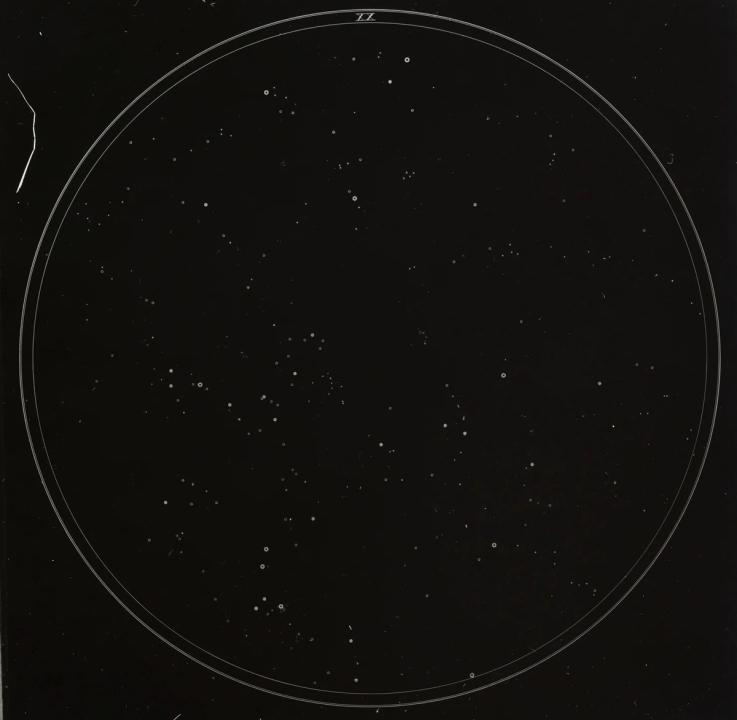
Leporis is a constellation just to the south of Orion, and R Lep is bright enough to be plotted in most atlases, at position (J2000) 04 59 36 -14 48 23. It is variable with a period of 427 days, and a highly eratic amplitude listed as 5.5 – 11.7 V mag. The most recent 4000 days of the light curve is presented in the figure above. This is made up of thousands of visual estimates provided to the American Association of Variable Star Observers.
R Lep is a highly evolved red giant, and a carbon star with a spectral classification of C7 IIIe. These pulsating variables are slowly and literally shaking themselves to bits. There will have been some carbon, nitrogen, oxygen, and so on, in the mostly hydrogen and helium new born star, then through nucleosynthesis they make more. Because of convective overshooting of the deepest layer into that above, and the further dredging up of that into the outer envelope by its convective action, the surface gets enriched with nuclear processed material. Although in fact it’s still overwhelmingly made up of hydrogen and helium. This material then gets systematically ejected into space by the pulsating instability of the envelope.
Carbon stars and red giants are the source of almost all the carbon, zirconium, strontium, and barium in the universe. The dusty shells around the carbon stars exhibit molecules like ethylene (C2H4), methyl cyanide (CH3CN), and many, many more. In the eyepiece when bright, R Lep looks like a far-off red hot lump of coal.
The difference between giants rich in carbon or oxygen is the ratio of C/O. Carbon has a great affinity for oxygen, and if there is more C than O, all the O gets tied up in molecules, leaving the surplus C to combine with itself. O-rich giants are defined by titanium oxide in their spectra – sunscreen, believe it or not – and are more important for putting silicates and nitrogen into space. The universal importance of these stars can’t be overstated. Carbon grains and silicates are the stuff on which metals and ices can condense in interstellar space, and provide little havens for more complex molecules to form in clouds, then to make more stars. The next generation of which will have a higher content of heavier elements than the last.
The carbon and nitrogen atoms in your body have first helped to make a star shine, then the carbon will have been puffed out as dust and complex molecules, and the nitrogen atoms may have been part of a planetary nebular. And you’re standing not far above the silicates, of course.
Alan Plummer