


Astronomical filter maker dies: Monty writes
0 Comments Published by Nick Lomb May 17th, 2008 in Amateur groups, ObservationsHydrogen Alpha filter (bottom) made by Del Woods and picture of the Sun taken with the filter (top), pictures Monty Leventhal
Solar observer and Member of the Sydney City Skywatchers, Monty Leventhal, regularly uses a Hydrogen Alpha filter made by Del Woods for his observations. Monty reports below that this pioneer of astronomical equipment for amateur astronomers has died:
It has been sadly announced that Del Woods, the retired founder of the DayStar Filter Company, passed away on the 14th May 2008. DayStar is a familiar name to professional and serious amateur observers of the Sun since February 1975 when Del Woods founded the company. Del Woods and his Company developed several series of specialized filters for visual and imaging applications that would come to be found in most professional solar observatories. DayStar Company developed Hydrogen Alpha filter series which were engineered to be more affordable for those amateurs who seek a rewarding solar observing experience. DayStar Company also engineers custom filter solutions for other scientific applications. DayStar Company was the first to set the standards for reliable, high performance Hydrogen Alpha and Calcium K-Line solar filters and harness this technology, rendering it attainable by many novice and amateur solar observers.
Prominence on the Sun observed with Hydrogen Alpha filter on the morning of 15 May 2008, image Monty Leventhal
This is a recent Hydrogen Alpha image of the Sun taken by Monty. It shows a spectacular solar prominence on the edge of the Sun. This was also observed visually from Sydney Observatory. Monty provides the following details:
Date:- 14-5-08
Time:- 22.25 [UT, 10 hours behind Sydney]
Conditions:- Excellent
Supported by the Donovan Astronomical Trust, Sydney. Australia.
Camera:- Canon 300D
Filter:- DayStar T-Scanner. 6Å.
Telescope:- Meade S.C. 10 inch
Similar posts:
The Flagstaff has arrived
0 Comments Published by Geoff Wyatt May 16th, 2008 in 150th anniversary, NewsWith thanks to the Bruce and Joy Reid Foundation, Sydney Observatory’s new flagstaff was delivered this morning at 3am! The donor tree was felled near Grafton NSW and with consent of the local Indigenous elders, was crafted into a magnificent 30m flagstaff.
Upon arrival it was skilfully lifted into the Fort Phillip forecourt to undergo the final stages of assembly.
Before the tabernacle was lowered into place a smoking ceremony was held by the craftsmen to acknowledge the history, culture and healing of the Grafton and Sydney Indigenous communities and to recognise the trees new home.

Tradition requires that a gold coin be placed under the flagstaff.
The flagstaff will be complete by Friday the 23rd of May and our wonderful collection of traditional maritime and astronomical flags will be unveiled on our 150th anniversary, June 5th.
Similar posts:
Getting Away with Murder: The Intriguing Case of a Diabolical Assassin
0 Comments Published by Geoff Wyatt May 14th, 2008 in 150th anniversary, Activities
With just 22 days until our 150th anniversary it’s time to talk about some of the great activities for the 7-9 June long weekend. Certainly one of the highlights will be a short play specially commisioned for us.
Getting Away with Murder: The Intriguing Case of a Diabolical Assassin June 7-9 at 1, 2, & 3pm.
On 8 September 1877, the Government Astronomer at Sydney Observatory discovered a package on his desk intended to be his end. Who wanted him out of the way and why? Investigation led to one prime suspect from amongst his staff. Come take a journey into the past and meet the characters to hear their side of the story, then you help decide how the story unfolds.
Get your tickets early and join one of the characters to uncover some clues before the main event.
Note additional cost of $5 per person applies to the general entry of $7 per adult and $5 per child.
Similar posts:

The time ball at Fremantle, Western Australia, photo by Allan Kreuiter
One of the Assistant Education Officers at Sydney Observatory, Allan Kreuiter, recently spent some time in Western Australia. While he was in Perth he was surprised to come across a working time ball. Here is his report:
The one pictured above overlooking Fremantle harbour has been going since March 27 1998. There is also a cannon that goes off at 1pm. This replica ball that looks a little like an inflated balloon is dropped every day at 1pm from a signal mast using a complicated series of ropes and pulleys by a dedicated team of historical volunteers. The mast also flies flags.

Time gun at Fremantle, photo by Allan Kreuiter
A cannon belonging to the Fremantle Dockers (a local Aussie Rules team) goes off when the ball ‘drops’ . On the edge of the mast you can see the edge of the “Round” tower or sometimes referred to as the round house (actually octagonal), which was originally a gaol, storage centre and barracks among other things. As well as having a signal station next to it!

The time ball and the signal mast at Fremantle, photo by Allan Kreuiter
The tower was built as a model jail in 1830 and is the oldest building surviving in WA, but Sydney’s time ball is older! For the original Fremantle Time Ball didn’t start dropping from an electronic signal from Perth Observatory until 1900, but services stopped in 1939 due to the advent of radio signals to ships. The original time ball looked much more robust than the current one.
Cheers
Allan Kreuiter
Similar posts:
Positions Vacant - Astronomy - rewarding but unpaid
0 Comments Published by Nick Lomb May 6th, 2008 in Amateur groups
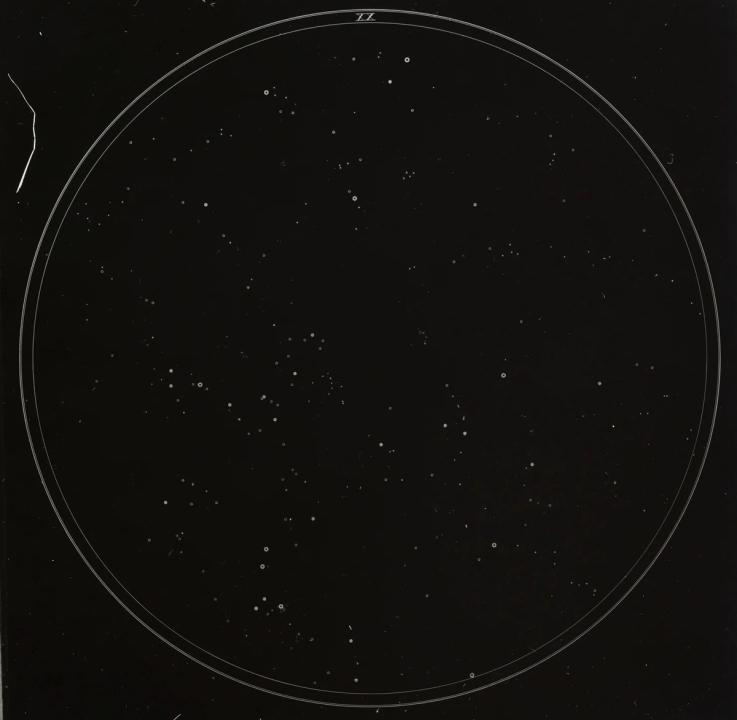
Star field DSS photo from AAVSO website
Enthusiastic Blue Mountains variable star observer Alan Plummer sends the following job advertisement:
OBSERVERS WANTED: Small telescope only req’d, dark sky or CCD not needed. On the job training. PAY: Beyond your wildest dreams. Immediate start. Apply below.
That’s not a joke. The American Association of Variable Star Observers (AAVSO) have recently published a prioritized list of Stars In Need Of Observation, called ‘Bulletin 71’. The AAVSO is perhaps the most direct way that amateurs like me can co-operate with their professional counterparts, and these ‘Stars In Need’ are a group of objects that are in the middle of an interesting and complicated part of their evolution: They are the red and slowly pulsating Long Period Variable stars (LPVs).
Some of these LPVs have been observed for a hundred years or more, and newer observers are needed to replace the old (who have become even more ‘heavenly’ perhaps?). Continuing observation by visual observers is needed for the sake of consistency with past observers, as obviously, CCD technology is a recent development. Also, a practiced visual observer can monitor many more objects than a CCD observer can, in the same time.
And the pay-off, you ask? When I started, I had no idea that I’d be able to co-operate so closely with the wider astronomical community, and to be contacted by people from around the world for help (often about my messy data, I’m unhappy to say) is special. The beauty of the objects goes without saying. But I can show you, at least. The photograph above is of the field around R Scorpii (in the cross hairs) along with some of the numbered comparison stars used to make an observation, and the globular cluster M80. This one’s on the priority list, and now in my program, so I get to look at this once a week or so! And every field observed has its own attractions.
If you’re interested, first go to the AAVSO website and download the free Visual Observers Manual , then post a reply on this site and we can take it from there.
Alan Plummer
(Sydney City SkyWatchers, AAVSO)
Similar posts:
May 2008 night sky podcast transcript
0 Comments Published by irma May 1st, 2008 in Sky guide transcriptsThis is a transcript of a podcast of the May 2008 night sky guide. Download and listen to the podcast as you gaze up at the night sky.
Nick Lomb: Hello. My name is Nick Lomb. I’m curator of astronomy here at Sydney Observatory. This is an audio guide for the month of May 2008. You can obtain this audio guide together with a transcript and a printable star map from the Sydney Observatory blog which is at www.sydneyobservatory.com/blog.
You can just listen to the audio guide but it is preferable to use it together with a printed star map. The audio guide is available from the blog or you can obtain it in the Sydney Observatory ‘Australian 2008 sky guide’. More details at the end of this sky guide.
Now to get the best out of the audio guide you need to know the cardinal directions. So you need to settle down outside, away from lights, and know which way is north, east, west and south because you need these directions to be able to know in which direction to look.
To be able to use a printed sky map, it’s good to have a torch which is with a red light. Now the easiest way to get the red light is just to put a bit of red cellophane in front of an ordinary white light torch. And you can just cut out a piece of red cellophane and put it in front of an ordinary white light torch with a rubber band.
So, once you’ve done that, settle down, and we’ll hopefully start to become familiar with the night sky.
So let’s start the guide to the night sky in May 2008 in the west where we find very low down, the planet Mercury. It’s not visible early in the month and it’s not visible late in the month, but in the middle of the month we can see the planet Mercury. And that’s nice to look at because many people have never seen the planet Mercury.
It never moves too far from the Sun which means that it’s only visible in the early evenings if it’s visible in the evenings. Or it’s visible in the early mornings just before sunrise if it’s visible in the mornings. It can never be visible late at night or in the middle of the night.
So it’s a planet that’s rarely seen so it’s good to have a look at it. And it’s reasonably bright very low down in the north-west.
Now if we go a little way above Mercury – again, in the western sky – we find the constellation of Orion. That’s one of the best known constellations in the night sky. It’s a constellation – or pattern of stars – that is best visible in the Australian summer. In May it’s still visible low down in the west. But we will soon lose it from the evening sky.
Orion is lying on its side. It’s a very easy constellation to recognise because there are four reasonably bright stars in a rectangle and three stars in a row which represent the belt of Orion. On the left, low down, we find the brightest star in the constellation; a star named Rigel. It’s a nice star to look at with a small telescope because it’s obviously a double star; obviously there are two stars there.
On the right of Orion, on the extreme right of Orion, a little bit near the top of the constellation, we find the reddish star, Betelgeuse. And that’s a red giant star; a star that is many hundreds of times wider than our own Sun.
If it was placed instead of our own Sun, so if it replaced our own Sun, it would engulf not just the planet Mercury but the planets Venus, Earth, and even the planet Mars. So it is a huge object. It is slightly cooler than our own Sun; that’s why it has the red colour, but it is a very interesting object. It’s one of the few stars in the sky where you can actually pick up that it’s not white but has this reddish colour.
Now if we extend Orion’s belt upwards, we reach a very bright star, and that’s the star Sirius, the brightest star in the sky. And this is a good example for which Orion is a very useful signpost. So it’s very worthwhile becoming familiar with Orion because it can then be used as a stepping stone to recognise other objects in the sky. So, as I said, by extending Orion’s belt upwards, we reach the star, Sirius, the brightest star in the sky.
If we continue going towards the north, we reach the two twin stars of Gemini, Pollux and Castor. These are two bright stars fairly close together in the sky. Pollux is the one higher up in the sky; Castor is the one lower down.
Castor is a very interesting star – that’s the one which is lower down. If we look at it through a small telescope, it’s obviously a double star. There are obviously two stars there. These two stars circle around each other. They take just under 500 years to circle around each other. But if it’s examined in great detail, then astronomers can see that there is actually a third star in the system. A faint reddish-coloured star. And then if you look at each of these three stars in more detail, looking at it through a device called a spectroscope or, more precisely, a spectrograph…. a spectroscope divides the light up from a star into its component colours – the colours of a rainbow. And the device that breaks the light up from a star which is placed on a telescope, and records this spectrum, the colours from the star, is called a spectrograph. And if you look at these stars with a spectrograph, we see dark lines – and these are standard in all stars – which tells us the conditions in the atmosphere of the star. But it also tells us the motion of the star. And each of those three stars that we can see in Castor – actually, the lines are double; they are made up of two stars. So in fact the system of Castor consists of six stars. So we can look at Castor and see one star with the unaided eye, with the naked eye – and in fact we’re looking at six stars. So that’s something rather interesting to note – basically, you’re getting six for the price of one.
The system of Castor is at 51 light years away, so light has taken 51 years to reach us from Castor. Pollux, which is a little way above Castor, is 34 light years away. It’s a giant, slightly reddish-coloured star which gives off as much light as 35 Suns. So it gives off as much light as 35 of our own Suns.
If we go further towards the north, we reach the planet Mars, which is a reddish-coloured planet. It is known as the red planet, Mars. And of course that’s being studied in very great detail these days – there’s a whole fleet of spacecraft circling around the planet and studying it in very great detail. And there are even two robot rovers which are moving around on its surface: Spirit and Opportunity, and which are providing a great deal of information about the geological history of the planet Mars. Certainly there are many interesting features which are associated with water, and water is something that we tend to associate with life. So maybe there was some kind of primitive life forms, primitive bacteria-type life on the planet in the distant past. There is no water on the surface today, so it’s unlikely there is life there today. But certainly in the distant past, there could have been some kind of primitive life forms.
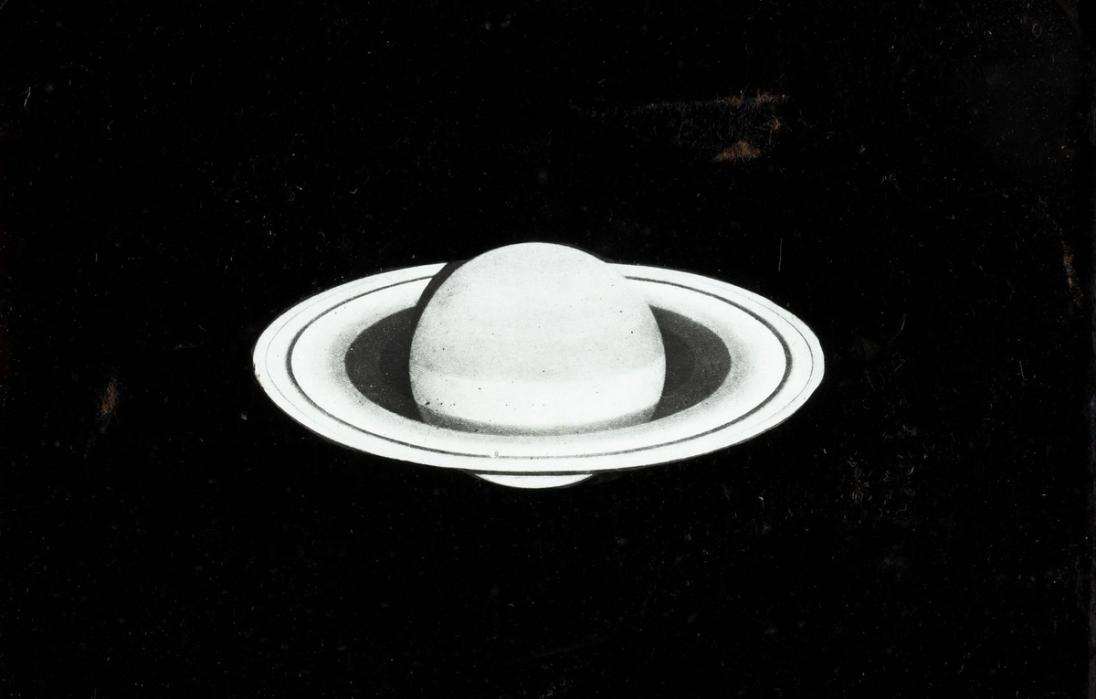
If we go further along, looking almost directly due north, maybe even a little way to the east, we come to the planet Saturn, and it’s very near to the bright star Regulus. Saturn is, of course, the most spectacular object in the sky to look at through a small telescope because Saturn has the beautiful rings circling around it. These rings as we look at them are getting a little bit thinner and thinner because we’re starting to look at them more and more edge on. And they’ll actually disappear some time next year – the rings of Saturn will completely disappear as we will look at them edge on.
And Saturn as I said is near the bright star Regulus, and that’s another interesting object to look at through a small telescope because it is a double star that you can see through a small telescope – you can see that it is made up of two stars circling around each other.
Now if we start looking, sort of move from Regulus further towards the east, so we’re looking almost due east, we reach the star, Spica, which is the brightest star in the constellation of Virgo the Maiden.
The way to find Spica is that above it there is a small group of stars in the form of a distorted rectangle. These are the stars of Corvus the Crow. And if we find this distorted rectangle in the sky and we extend two of the stars downwards, we reach the star, Spica.
Spica is a double star but it’s not a double star that we can see through an ordinary telescope. it can only be noticed through a spectroscope or a spectrograph. As I explained earlier, the spectrograph is a device that records light being broken up into its components.
And with the spectrograph we can see that Spica is made up of two stars very close together. So we cannot see them separately through an ordinary telescope. But with a spectrograph we can notice that they are made up of two stars close together and circling around each other every four days.
One thing we can notice if we look very carefully through a telescope, is that the brightness of the two stars – of what appears to be one star – varies over those four days. And the reason they are changing over four days is because the two stars are so close together that they distort each other. They are not spherical stars, but they have been stretched out into the shape of footballs. And as we look at those football shapes from different angles, the brightness of the ‘star’ changes. It’s a very small effect. It needs to be very carefully monitored. But astronomers have found this variation – that the ‘star’ does vary very slightly in brightness due to these different aspects – whether we’re looking at the football shape face on or we’re looking at it edge on and then it appears round, then it’s a little bit fainter. If we’re seeing less of the star then it appears just that little fractionally fainter. And what makes that system even more interesting; the brighter or the larger of the two components is also a variable star. It varies in brightness by a period of about four hours. Over a period of about four hours there is a few per cent change in brightness, and that is because the star is pulsating – it is becoming bigger and smaller as time goes on.
The system of Spica is 260 light years away so its light has taken 260 years to reach us from Spica. It’s now 2008, so the light was emitted back in the 1700s, 1740s when the light from Spica was emitted. And together the two stars radiate as much light as more than 2000 of our own Suns. So 2000 times the brightness of our own Sun.
Let’s look towards the south…. and, in the south we can see the Southern Cross starting to be reasonably high up on the south-east. If you think about the Southern Cross as the hour hand of a clock, then in May in the early evening it’s somewhere between 10 o’clock and 11 o’clock in position. So it’s fairly high up in the south-eastern sky.
Below the Southern Cross are the two Pointer stars, Alpha and Beta Centauri. Beta is the one which is closer to the Cross in the sky while Alpha is the one that is further away from the Cross in the sky. But in fact it’s the closest star system to the Earth, and light from Alpha Centauri has taken only four years to reach us. So the light from Alpha Centauri which we’re looking at at the moment left Alpha Centauri in 2004. So, not very long ago. While Beta Centauri is much further away, it’s something like 500 light years from us. The light from Beta Centauri left around 500 years ago so it’s around the 1500s which is long before Europeans set foot in Australia, and at the time that the Renaissance was happening in Italy. So it’s a long time ago.
We can use the Southern Cross to find the brightest star in the constellation of Carina and that is the star Canopus. And Canopus is the second brightest star in the sky after Sirius. We talked about Sirius. Sirius is high up in the north and it can be found by extending the belt of Orion. Canopus can be found by extending the top two stars, or what are the two top stars of the Southern Cross at the moment extended to the right towards the west and the first bright star we come to is Canopus, the second brightest star in the sky. And we’ll talk about Canopus in more detail when we have the guide to the night sky for June 2008.
So that almost completes the guide to the night sky in May. But I shall tell you that early in the month, we have a meteor shower – one of the brightest meteor showers that is visible to us in the southern hemisphere. And it’s the meteor shower called the Eta Aquarids, and this meteor shower is associated with Halley’s Comet. Every year around this time in early May we run into a stream of particles that has been thrown off from Halley’s Comet over many thousands of years as Halley’s Comet circles around the Sun.
And as we run into this stream of dust particles, these dust particles hit the Earth’s atmosphere, and as they burn up we see a streak of light. The best chance to see the meteor shower is in the early morning of Tuesday 6th May, and this year we’ll have a fairly good chance as there is no Moon in the sky to brighten up the sky. So if you can find a nice dark spot early in the morning before sunrise of Tuesday 6th May, and look in the eastern sky, and you should see streaks of light from Halley’s Comet.
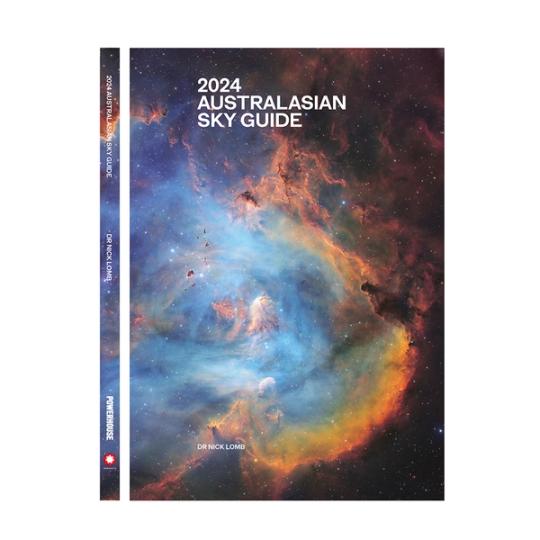
That completes the guide to the night sky in May 2008. This podcast, this guide, is available from the Sydney Observatory blog site: www.sydneyobservatory.com/blog. You can also get more information about the night sky in the ‘2008 Australian sky guide’ available from Sydney Observatory, online from the Powerhouse Museum and from good bookstores. The cost is only $16.95 though if purchased online there is also a postage cost. And, as the author, I highly recommend the publication.
My name is Nick Lomb, and this was the guide to the night sky in May 2008.
Similar posts:
- None Found
May 2008 night sky guide and podcast
2 Comments Published by irma May 1st, 2008 in Monthly sky guidesTo help you learn about the southern night sky, Sydney Observatory provides a night sky star map or chart for each month of the year. We also provide an audio guide of the month’s night sky, presented by one of Sydney Observatory astronomy experts - this month, Dr Nick Lomb, the Museum’s Curator of Astronomy. You can listen online, or download the audio onto your ipod or mp3 player. Links to the audio and the star map are below.
Among highlights for this month, Nick tells us we should be able to see streaks of light from a meteor shower in early May. This meteor shower, the Eta Aquarids, is caused by particles thrown off by Halley’s Comet. The best time to see it is on the early morning, before sunrise, on Tuesday 6 May. It should be a particularly good opportunity to see it this year as there is no Moon then.
Also visible this month are the planets Mercury, Mars and Saturn (best to catch it this year as the rings will disappear during next year because of the angle Saturn will be at relative to the Earth), and the constellations Orion, Gemini and the Southern Cross.
For much more information and detail in star charts for months from December 2007 until December 2008 inclusive, plus information about the Sun and twilight and the Moon and tides, and a host of other fascinating astronomical information, we recommend you purchase (only $16.95 and available now) the 2008 Australian sky guide by Sydney Observatory’s Dr Nick Lomb. Available online and at Sydney Observatory and Powerhouse Museum shops.
The free monthly night sky map PDF (below) shows the stars, constellations and planets visible in the night sky from anywhere in Australia. To view PDF star charts you will need to download and install Adobe Acrobat Reader if it’s not on your computer already.
Read the transcript.
Similar posts:
- None Found
The changing brightness of the planet Mars
0 Comments Published by Nick Lomb April 30th, 2008 in Information
The Moon and the red planet Mars on 27 November 2007. Picture taken by Bonny Foley Brennan, an Aboriginal Artist from the Boolarng Nangamai Aboriginal Corporation, of Gerringong NSW
The above picture was sent to me by Steve to identify the smaller object near the Moon. I calculated what the sky looked like on the given date of 27 November using a suitable computer program and established that the planet Mars was near the Moon that night. So what we have is a nice picture of the Moon together with the red planet Mars.
Mars is fairly bright on the picture, much brighter than Mars is in the sky at the moment. Why does the brightness of the planet change so drastically?
The apparent brightness of a planet in the sky depend on its distance from Earth and its distance from the Sun. For a distant planet like Jupiter there is little change in brightness as there is little change in either distance. With Mars there are large changes as its distance from Earth varies. Mars is further from the Sun than Earth so it moves more slowly. Every two years or so the Earth catches up with Mars as they both circle the Sun and the two planets are in line with the Sun. That is called opposition as the Sun and Mars are then on opposite sides of the Earth. Opposition is when Mars is at its closest to Earth and at its brightest.
Of course, it is more complicated. Mars has an elongated path around the Sun. Sometimes when we catch up with it it is further from the Sun than at other times while sometimes it is closer. If we catch up with Mars at a close point astronomers talk about a favourable opposition. Favourable oppositions occur roughly 15 years apart. Distances of Mars at different oppositions are listed below:
Year Distance
2003 56 million km favourable
2005 69 million km
2007 88 million km
2010 99 million km
2012 101 million km
2014 92 million km
2016 75 million km
2018 58 million km favourable
Similar posts:
Harry sees spots, prominences and other activity on the Sun
0 Comments Published by Nick Lomb April 17th, 2008 in ObservationsA spectacular prominence on the Sun on 19 March 2008, a few days before the events that Harry describes below. Image Monty Leventhal
After months of inactivity March 24th was a day to remember – around noon through clouds two spot groups were seen about twenty degrees apart, and next day; a third group joined. The three now spread across ~60º of longitude, and about 10º south latitude; clearly late Cycle 23 activity.
The three groups were surprisingly active, with bursts of flares capped by an M1.8 flare on March 25th (the strongest for years). Two outstanding features of the sunspot trio were a pair of attendant filaments, one a large quiet region filament (QRF) the other a small dark active region filament (ARF).
The QRF appeared on 2008 March 23rd well before the spot groups as a bright prominence at the east limb between –20º to –25º latitude, 232º longitude and 25,000km high. Next day as spot groups AR987 and AR988 were emerging the prominence was seen as a dark filament well south of AR 988.
The QRF grew larger as it neared the central meridian, stretching across 20º of longitude on 28th; the largest for some time. Around the 29th it perhaps ejected from the disc as it became hard to see, and patrol images showed only bits of the original. Events would show it must have quickly reformed.
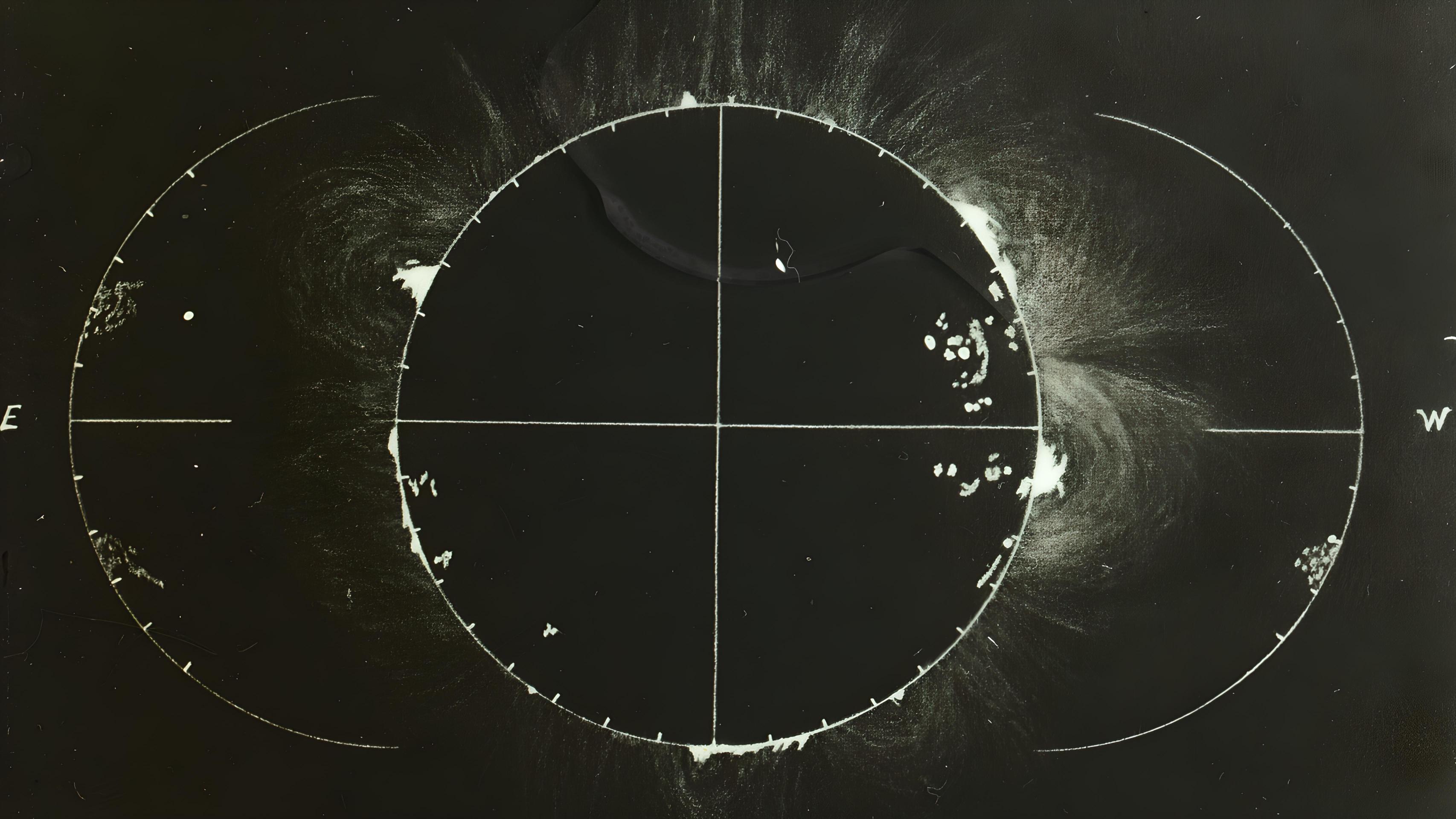
A prominence on 5 April 2008 (wrong month on diagram), drawn by Harry Roberts
The spot groups neared the west limb around April 2nd, then passed behind it on the 4th (Fig 1). The view on the 5th was memorable: a large bright and complex prominence stretched around 12º of the SW limb from –17º to –29º latitude, with a very bright central arch rising to ~60,000km, the biggest prominence for a long time. At the base of the prominence parts of the big filament could still be seen near the limb, so there was no doubt that the great filament had become a great prominence. Subtle changes suggested it was ejecting at a snails pace, with the central brightest component separating from its neighbours, but little change was seen before viewing ended at 05:50 UT.
Prominence on 5 April 2008 (wrong month on drawing), drawn by Harry Roberts
Resuming at 21:51UT (next morning, but also the 5th) showed the large prominence was in fact still ejecting 16 hours later (Fig 2); the adjoining components had gone, and the central part now described an arc 100,000km high and 70,000km wide at the base, the largest prominence for years.
Activity in this southern zone between 200º to 260º longitude seems, inexplicably, to be increasing. The region has hosted many spots over the past eight months, and is notable for the presence of a coronal hole with strong open northern field that seems to be strengthening. I wonder if the patch of northern field amid the many smaller coronal holes with open southern field is the reason for the increasing sunspot and prominence activity there.
Harry Roberts (Sun and Moon observer and member of the Sydney City Skywatchers)
Similar posts:
Solar cycle 24: The second spot group appears! - Harry Roberts reports
0 Comments Published by Nick Lomb April 14th, 2008 in ObservationsThe new sunspot in white light on Sunday morning 13 April 2008 (note Australian EST is 10 hours ahead of UT), drawn by Harry Roberts
Sunwatching at present is exciting, as Cycle 23 is still active, yet C24 activity is expected daily. Setting up the ‘scope promises the unexpected.
The morning of April 13th (still 12th UT) was such a day; after brief H-alpha observation through passing cloud of some small prominences I switched to white light to search for sunspots, finding none in spite of good seeing and, I thought, a careful search. The phone rang: it was Monty Leventhal to say there was a spot near the NE limb – he had not seen it but emails from US observers reported bright H-alpha plage there and one or two had seen spots at the site. Back to the ‘scope: still set up for white light viewing.
Setting the cross-hair eye-piece on the NE quadrant I searched for bright faculae – recalling that an H-alpha patrol image of the 12th had a small bright patch in the NE.
It was hard to find, since the patch had moved away from the limb and the faculae was faint, yet there it was. It comprised a triangle of facular threads that were fairly bright. No spot could be seen at 80X but at 160X I found a single small black spot. Back to 80X and the spot was now easily seen, making transit timing possible.
The new sunspot in the light of hydrogen atoms, drawn by Harry Roberts
In H-alpha (again) the site was easily seen, with two bands of bright plage, and a dark spot, that seemed in a slightly different position from the white light spot (?).
“Helio” calculations gave the position as latitude 27º N, longitude 359º. Spots this small are not counted by many sunwatchers, and various groups require a spot to visible for more than 24 hours for it to be counted. I felt that Mt. Wilson would have detected the spot but their daily drawing was not yet available, nor was their digital magnetograph. But a Solar Monitor magnetogram showed the new region had reversed polarity and was most likely a C24 group; the high north latitude confirming this.
It is worth noting that the new cycle has produced only northern hemisphere spots so far, while old cycle (23) activity dominates the southern hemisphere. The first accepted C24 spot was AR981 located at 28ºN, longitude 248º on January 6th. The new group glows brightly on SOHO UV and EUV images. The two sketches record the view in white light and H-alpha, and the position on the sun’s disc.
The tiny sunspot group is unspectacular at the time of writing (it might grow more obvious) – but it probably has the distinction of being the second spot group for solar Cycle 24.
Harry Roberts (Sun and Moon observer and member of the Sydney City Skywatchers)
Similar posts:
About
Observations is run by the staff of Sydney Observatory located at Observatory Hill, The Rocks, in Sydney, Australia.
This site is for discussion purposes only and does not represent the official views of Sydney Observatory. Any views expressed on this website are those of the individual post author only. Sydney Observatory accepts no liability for the content of this site.
Please direct any correspondence to sebc [at] phm.gov.au.
Categories
- 150th anniversary (2)
- Activities (17)
- Amateur groups (46)
- Information (76)
- Lights in the sky (11)
- Monthly sky guides (19)
- News (42)
- Observations (61)
- Reports (29)
- Sky guide transcripts (16)
- Uncategorised (12)
- Upcoming sky events (4)
- Work experience (4)
Latest
- Astronomical filter maker dies: Monty writes
- The Flagstaff has arrived
- Getting Away with Murder: The Intriguing Case of a Diabolical Assassin
- Time ball at Fremantle: Allan reports
- Positions Vacant - Astronomy - rewarding but unpaid
- May 2008 night sky podcast transcript
- May 2008 night sky guide and podcast
- The changing brightness of the planet Mars
- Harry sees spots, prominences and other activity on the Sun
- Solar cycle 24: The second spot group appears! - Harry Roberts reports