





Agnes Clerke: “Daughter of the Revolution” – Musings by Harry Roberts

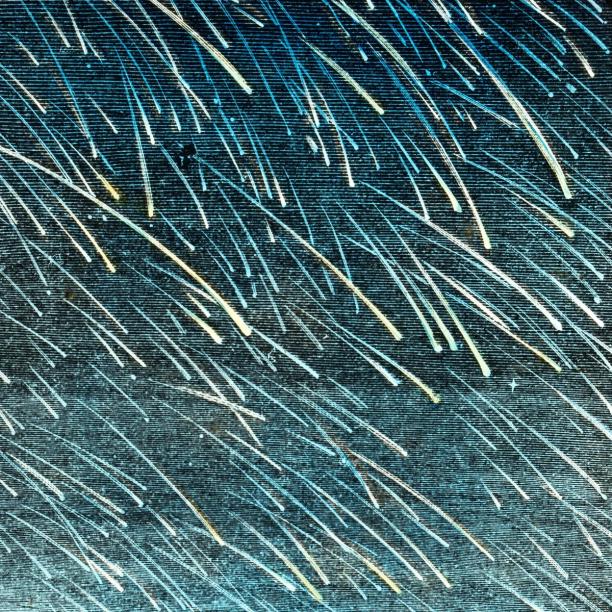
The spectrum of the star Gamma Velorum, lyrically described by Agnes Clerke (see below), courtesy Harry Roberts
Born in County Cork in February 1842, Agnes Clerke showed a precocious interest in astronomy, commencing to write a history of the science when she was only fifteen! Although Rükl in his Moon Atlas states she was a “British astronomer”, she never did any observational work of her own. She was a pioneer, however, in being an early populariser of astronomy, an historian of the science, and a student of astrophysics, posing many problems for observational astronomers to grapple with.
Clerke was a “modernist” in foreseeing that astronomy would play a leading role in the emergence of scientific reason in the coming (twentieth) century. She was particularly attracted to the new technique of spectroscopy, with its remarkable power to “know what the stars were made of’”. Indeed, it would be difficult to overstate the role spectroscopy would play in the new century.
In 1888 she spent some time at the Cape Observatory as guest of Sir David Gill and his wife, and it was there, perhaps, that she first saw the spectra of stars through the eyepiece. The experience allowed her to write with authority in 1905 about the spectrum of Gamma Velorum “which was studied with care and much delight by Dr. Copeland in the Andes in 1883” stating that:
“An intensely bright line in the blue, and the gorgeous group of three bright lines in the yellow and orange, render the spectrum …incomparably the most brilliant and striking in the whole heavens.” She added that “a vivid continuous spectrum extends into the violet as far as the eye has power to follow it, and accounts for the brilliant whiteness of the star.” (see drawing of spectrum above).
The “blue” line is an emission line of the element carbon, heated to ~30,000ºK in the atmosphere of the unseen Wolf-Rayet companion (spectral class WC7) of Gamma Velorum 2. Ms. Clerke would surely marvel if she knew how far spectroscopy has come in the century since she recorded these impressions.

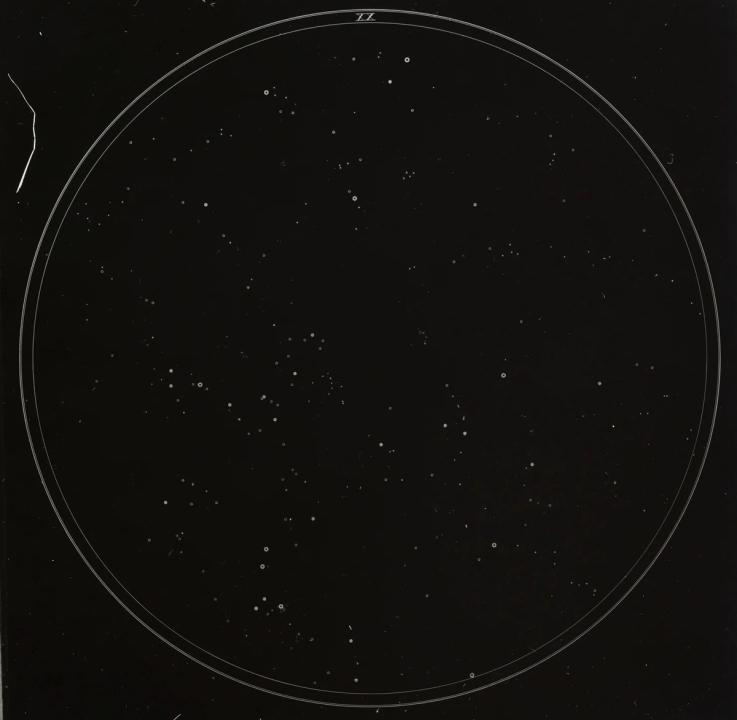
Crater Clerke drawn by Harry Roberts
In southeast Serenitatis you will find the lunar crater that commemorates her (above). I came across it on 2006 August 31 by accident, amazed by the combination of very dark lavas and brilliant young impact craters, as the sketch shows. The nearest named crater was Clerke; and I reflected on Agnes’ career, and remembered her words on the Gamma Velorum spectrum (see Burnham’s Celestial Handbook Vol. 3 page 2035). As I have an eyepiece spectroscope I know its spectrum well, and often point the ‘scope at the star to gaze at those “gorgeous” emission lines: by far the brightest Wolf-Rayet (emission line) star in the whole sky. At declination 47º south it’s out of reach of most northern viewers; another jewel for us southern observers to enjoy!
Crater Clerke is very close to the Apollo 17 landing site, where geologist Schmidt had so much fun, and had to be dragged back into the module when time ran out…becoming the last man on the Moon. This is the complex Taurus-Littrow region, and the astronauts were drawn there by the very dark lavas thought to be recent deposits. When samples of the ”black” lavas were analysed they were found to be quite ancient, consisting of black and orange volcanic glass beads that had been “sprayed into the lunar sky from a nearby lava fountain.” (Wow! “Modern Moon” by Wood, page 78.)
The sketch shows some of these “black” lavas where they “ooze” out across the lighter grey Serenitatis lava field. In fact the black lavas form dark cliffs that tower over the main basin flows; a bit like the cliffs that form the Sydney beachside headlands. At the top (north) of the figure a twin impact site forms two intensely bright sprays of impact debris that are (almost) the brightest on the Moon, and contrast starkly with the Taurus-Littrow dark mantling. Overall, it’s an amazing site. And presumably Agnes would be pleased with this “gorgeous” memorial.
Crater Clerke is ~7km in diameter, and is fresh, i.e. Copernican Era, 1.1 By up to the present. It has a fairly bright glacis, though not as bright as the small craters just to the north. It’s worth a close look. So is the spectrum of Gamma Velorum.
Enjoy the Moon.
-
Nick Lomb
-
http://ias1937hotmail.com Deirdre Kelleghan